
On the cover: Social mobility
Degrees of choice
Jo Blanden, Oliver Cassagneau-Francis, Lindsey Macmillan and Gill Wyness
Bolder applications mean that private school pupils end up at better universities than their exam results predict
The university that young people attend and the subject they study can shape their entire future. Research from the UK (Britton et al, 2019) and the United States (Chetty et al, 2020) shows that these choices play a major role in the earnings differences among those from richer and poorer families, making higher education a powerful driver of social mobility. Yet, access to the most prestigious university courses remains unequal, and one key factor behind this is the type of school a young person attends before university.
Despite making up just 7% of the pupil population at age 16, the alumni of private fee-paying schools dominate elite professions (Hecht et al, 2020). These schools are known to bestow important advantages on their pupils, such as enhanced academic preparation, advice on future pathways and increased social capital (Cattan et al, 2022).
Many pupils from disadvantaged backgrounds end up at less selective institutions than their grades would suggest
Grammar schools, which are state-funded, also offer their pupils advantages in the labour market due to their selective nature and high academic standards. Together, these elite institutions help to shape who gets into top university courses and, by extension, who gets ahead in life.
Our research examines how pupils from private and grammar schools access university courses, compared with those from nonselective state schools and further education (FE) colleges - not just through exam results, but through the choices that these young people make.
Mismatching academic abilities and university courses
To explore these issues, we use our "mismatch" framework developed in previous work (Campbell et al, 2022). This looks at whether young people attend university courses that match their academic ability.
Ideally, someone with high grades should attend a highly selective university course. But in reality, many end up at less selective institutions than their grades would suggest, especially those from disadvantaged backgrounds - an outcome known as "undermatch". Conversely, "overmatch" occurs when young people attend more selective courses than expected based on their grades.
Our research shows that young people from private and (to a lesser extent) grammar schools are significantly more likely to overmatch and less likely to undermatch compared with their peers from the nonselective state sector.
The most striking disparities between grades achieved and course attended occur among lower-attaining pupils
This pattern holds across the achievement distribution - not just among top achievers. Indeed, the most striking disparities occur among pupils in the lower half of the attainment range. For example, privately educated young people in the 30th to 50th percentile of academic performance at age 18 attend university courses ranked up to 15 percentiles higher than their state school counterparts (see Figure 1).
Figure 1: School type mismatch by pupil achievement and coure quality
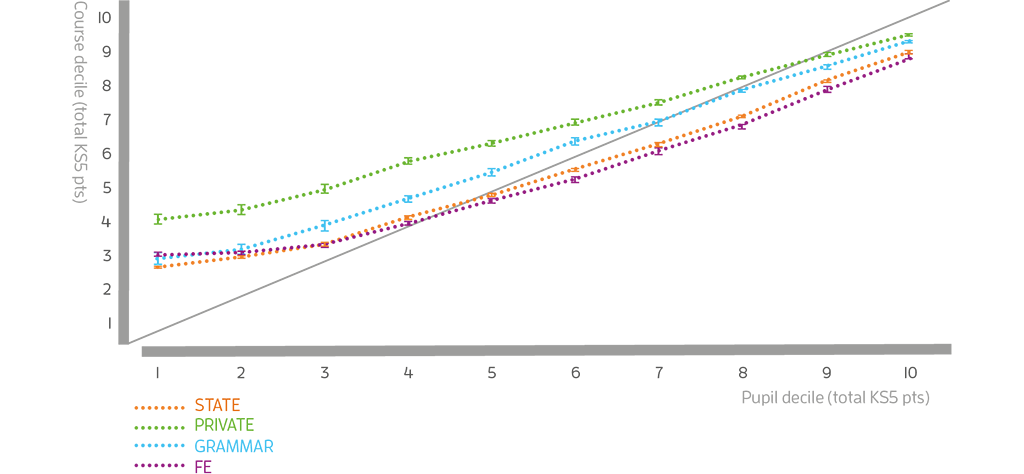
Source: National Pupil Database and Higher Education Statistics Authority Note: The 45-degree line represents perfect matching throughout the achievement distribution. Pupils are ranked by their total key stage 5 (KS5) points. Courses are ranked by the median pupil's total KS5 points. Eorror bars represent 95% confidence intervals.
We can also look at the extent to which these mismatch gaps change when we take account of other characteristics including prior academic attainment. The advantage enjoyed by grammar school pupils compared with those attending other state school provision seems to come almost entirely through their high academic attainment at GCSE level. After taking this into account, grammar school pupils look similar in terms of enrolment match to their counterparts in state schools and FE colleges.
This is not the case for private school pupils; even when we control for academic achievement at both age 16 and age 18, private school pupils still attend much higher ranked university courses than their peers of similar achievement.
Ambition versus risk aversion
We show that pupils' applications strategies are a major driver of these gaps (see Figure 2). In the UK, young people submit up to five applications through a centralised system called UCAS. Private school pupils make a larger number of ambitious choices, applying to "reach" or "matched" courses for most of their choices, and selecting fewer "safe" options. Pupils at state schools and FE colleges are much more risk-averse in their choices.
Figure 2: Mismatch in degree applications
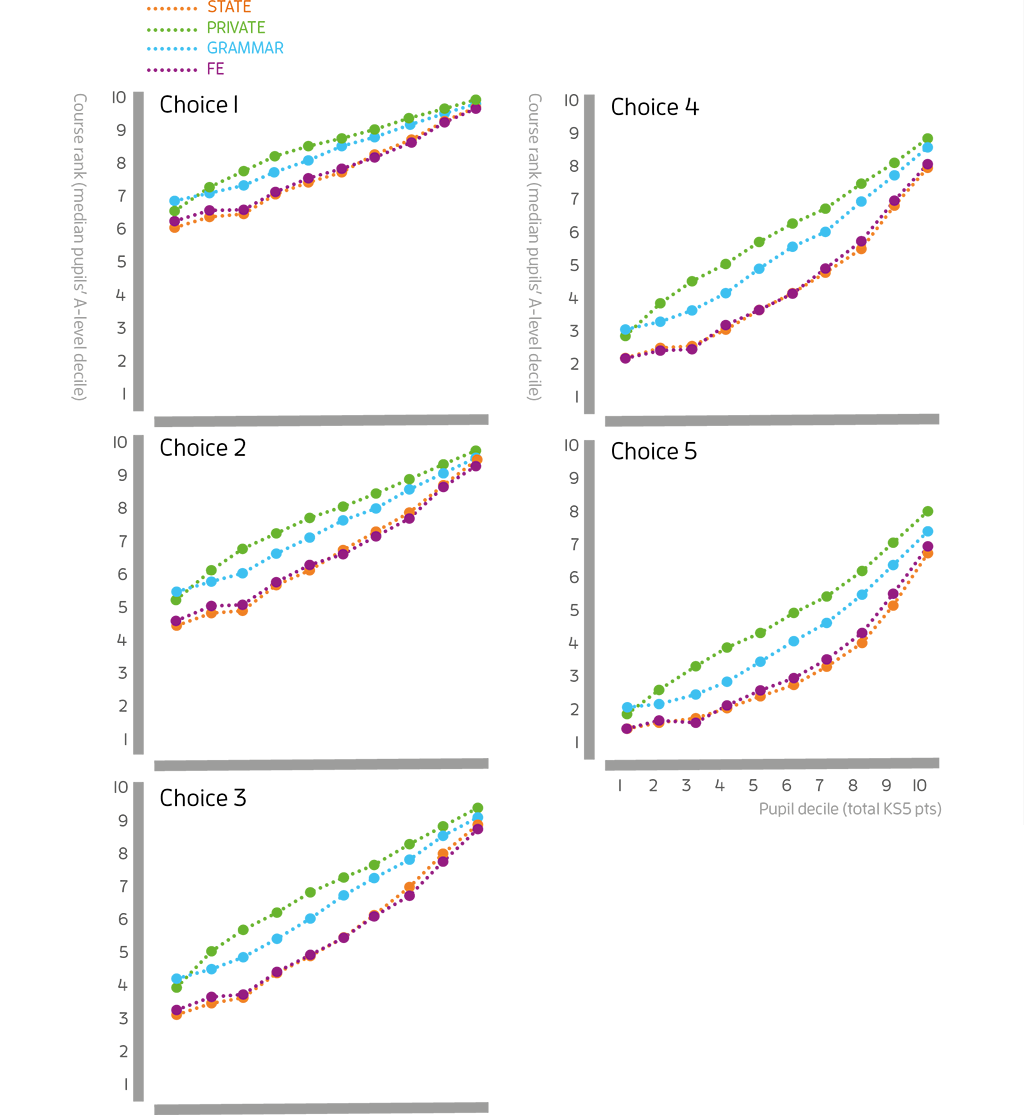
Source: Grading and Admissions Dataset for England Note: Here we reproduce the pupil decile-course decile plot from figure 1 for the universities appliced to (rather than enrolled in). Pupils can make at most five choices, so we have ranked their choices in the same way we rank courses for our mismatch measure, presented in panels labelled correspondingly (from "Choice 1" to "Choice 5"). Only pupils who made four or five choices are included in the sample for this figure.
While we cannot observe the mechanisms through which these gaps occur, comparing these mismatch patterns of pupils from private schools to other school types allow us to speculate about the reasons these inequalities may be occurring. Bearing in mind that grammar schools applications seem to fall in between state and private schools, it is useful to compare the patterns of private and grammar school pupils. Since these school types have much in common, this helps us to rule out potential explanations.
Private school pupils are less likely to include 'safe' choices withing their five applications, implying they may be more willing to take risks
For example, financial resources or a culture of post-school progression to elite universities may provide the explanation. Private schools are likely to have a strong culture of progression to higher education. But grammar schools also send high proportions of pupils to university, including highly selective institutions (Montacute and Cullinane, 2018), suggesting the difference is not only about a general culture of university aspiration within the school. Similarly, we would expect grammar school pupils to have similar levels of academic preparation and ambition, as well as parental motivation or know-how, suggesting that these factors can't fully explain the differences either. Lower risk aversion (perhaps through increased confidence), coupled with school (and parental) financial resources may provide more compelling explanations. Private school pupils are less likely to make "safety school" applications, implying that they may simply be more willing to take risks.
The greater financial safety net enjoyed by private school pupils may also lessen the impact of making bolder applications. Similarly, the high degree of social capital generated through networks, relationships and access to opportunities that pupils gain through their attendance at private schools may play a role. Ultimately, however, we can only speculate on the mechanisms through which the differences between pupils from different school types are occurring.
If access to top universities is shaped not just by ability but by school efforts to widen participation must start earlier
These findings raise important questions for policymakers. If access to top universities is shaped not just by ability but by systematic differences across school types, then efforts to widen participation must start earlier in the educational pipeline. It's not enough to focus on university admissions alone: we need to look at how pupils are supported in making choices, how they feel about the risk of making ambitious choices, and what information they have about their options.
Ensuring that all young people - regardless of background - understand the application process, feel confident in their choices and have access to high-quality advice is essential. Addressing these disparities could unlock talent and improve both equity and efficiency in higher education.
This article summarises "Private highs: investigating university overmatch among students from elite schools", CEP Discussion Paper No. 2115. An earlier version first appeared on LSE British Politics and Policy.
Jo Blanden is a professor of economics at the University of Surrey, a research associate in CEP's education programme and a research affiliate at the University College London (UCL) Centre for Education Policy and Equalising Opportunities (CEPEO). Oliver Cassagneau-Francis is a senior research fellow at CEPEO. Lindsay MacMillan is a professor of economics at UCL and the founding director of CEPEO. Gill Wyness is a professor of economics at UCL, deputy director of CEPEO and a research associate in CEP's education programme.
Further reading
Britton, J., Dearden, L., Shephard, N. and Vignoles, A. (2019) 'Is improving access to univesrsities enough? Socio-economic gaps in the earnings of English graduates', Oxford Bulletin of Ecxonomics and Statistics, 81(3), 328-368.
Campbell, S., Macmillan, L., Murphy, R. and Wyness, G. (2022) 'Matching in the dark? Inequalities in student to degree match', Journal of Labor Economics, 40(4), 807-850.
Cattan, S., Salvanes, K.G. and Tominey, E. (2022) First generation elite: the role of school networks, IZA Discussion Paper No. 15560.
Chetty, R., Friedman, J.N., Saez, E., Turner, N. and Yagan, D. (2020) 'Income segregation and intergenerational mobility across colleges in the United States', Quarterly Journal of Economics, 153(3), 1567-1633.
Hecht, K., McArthur, D.J., Savage, M. and Friedman, S. (2020) 'Elites in the UK: pulling away? Social mobility, geographic mobility and elite occupations', Sutton Trust.
Montecute, R. and Cullianane, C. (2018) 'Access to advantage', Sutton Trust.
20 February 2026 Paper Number CEPCP724
Download PDF - Degrees of choice
This CentrePiece article is published under the centre's Education programme.
This publication comes under the following theme: Higher education