
Behind the news: The Nobel Prize
Philippe Aghion: explaining sustained growth through creative destruction
How the study of innovation and competition has been transformed.
My first thought on hearing that my friend and co-author Philippe Aghion had won the Nobel Prize in Economic Sciences was "well, it's about time".
Philippe has deservedly received just about every other prestigious economics prize: from the Yrjö Jahnsson Award in 2001 to the BBVA Foundation Frontiers of Knowledge Award in Economics in 2020. Now, he is co-recipient of the 2025 Sveriges Riksbank Prize in Economic Sciences in memory of Alfred Nobel, together with Peter Howitt, of Brown University, and Joel Mokyr, of Northwestern University.
As the full Nobel citation elegantly describes, his 1992 paper, jointly written with Howitt: "A model of growth through creative destruction" - lays the modern analytical foundation for understanding economic growth.
There are two key building blocks. First, non-rival research and development (R&D) spills over to other firms. Future innovators "stand on the shoulders of giants", using past knowledge to generate new ideas. This positive intertemporal externality means that the original inventor only captures a small fraction of the total social benefit of innovation. As Gustave Flaubert said in his Dictionnaire des idées reçues: "Inventors - All die in the poor house. Someone else profits from their discoveries, it is not fair." This indicates that society can benefit from subsidising R&D.
The second building block - and pulling somewhat in the opposite direction - is the fact that when competition is imperfect, innovations by successful entrepreneurs create profits for their company while their rivals see profits drop, a process known as "business stealing". This makes the process of innovation inherently disruptive, as it creates losers as well as winners.
The 1992 paper combined these forces in an elegant general equilibrium model, which provided a manageable way of addressing questions on growth.
Protection versus competition
The decentralised market economy will not generate socially optimal levels of innovation. Knowledge spillovers will generally lead to underinvestment, but business stealing will push towards overinvestment. Which effect dominates is ultimately an empirical issue, although the evidence tends to show that there is too little R&D investment, with social returns outstripping private returns by a considerable margin.
Crucially, modern endogenous growth theory breaks with the traditional view that total factor productivity (TFP) growth is "manna from heaven". Governments can and do influence the rate of growth through changing the rate (and direction) of technical change for both good and ill.
This is important for current debates. Productivity growth in the UK and elsewhere has slowed down precipitously since the global financial crisis of 2007-09, but we do not have to accept this as inevitable. Better policies and institutions can make a difference. Philippe himself has been deeply immersed in these policy debates as a commentator and adviser to governments.
A successful society must embrace the dynamism of creative destruction and provide ballast against incumbents exploiting market power
The battle over the rents from innovation creates incentives for more R&D. But it also incentivises incumbents to create barriers to make it harder for new entrants to displace them. This could be in the form of lobbying and business practices. A successful society must embrace the dynamism of creative destruction and provide ballast against incumbents exploiting market power to entrench their positions.
The precise forms of policy interventions are often subtle, as the theory gives reasons for why there may be too much destructive innovation due to business stealing. Innovation creates losers and can therefore widen inequality. But the key aspect is to remove barriers to potential inventors and entrepreneurs, for example, through improving access to quality education and training to those from less well-off backgrounds.
From macro theory to micro empirics
The Aghion-Howitt paradigm bridged macroeconomic growth theory with microeconomic insights from industrial organisation. The paper coincided with the opening up of rich seams of panel data on firms from administrative, accounting and survey sources. These increasingly matched information on productivity, jobs and innovation measures, such as patents and R&D. These data enabled both rigorous testing of models with more credible methods, and the subsequent refinement and development of growth theory.
One example of the interplay of data and theory is work on the relationship between product market competition and innovation. Models of endogenous growth without creative destruction generally predict that competition reduces the incentives for innovation, because it erodes the temporary product market rents that flow from new ideas. This prediction is in tension with much firm-level panel work from the 1990s onwards, which found that competition tended to increase innovation.
Aghion-Howitt suggested a "step-by-step innovation" extension to the basic growth model that allowed firms to have different positions on the innovation ladder and undid the simplistic Schumpeterian prediction. In this model, when firms are neck and neck, rather than too far ahead or behind, there are strong incentives to innovate to escape competition. Consequently, the impact of competition depends on the specific context.
At the macro level, these offsetting forces can generate an "inverted U" relationship, where stronger competition generally increases innovation, but can reduce it when rivalry is already very intense.
A second example is the explosion of work on firm dynamics. The entry and exit process is fundamental to the spread of innovation in Aghion-Howitt and the new firm micro data enabled a detailed documentation of firm turnover and its relationship to productivity growth.
Research shows that about 10% of US firms enter or exit each year. This turnover is mainly within quite specific industries, so it is more than a structural transformation across sectors. Higher turnover is associated with greater productivity and reallocation of resources between firms (and within firms), which accounts for a substantial fraction of aggregate TFP growth.
An innovative life
Almost three decades after the Aghion-Howitt paper, I helped to organise a four-day conference in Paris to map out the impact of their work on the profession. Hundreds of scholars, many Nobel laureates and even the French president discussed the work. The publication that came out of this event documented Philippe's profound influence not only on growth and industrial organisation, but also on fields as diverse as trade, labour, taxation, the environment, political economy, finance and organisational economics.
What's striking is not just Philippe's intellectual influence on the profession, but also how he has co-authored with so many other scholars to advance knowledge. He is generous in offering his time to young researchers. He is an innovator par excellence, never content to rest on his laurels and always hungry for the next challenge and the next big idea.
On a personal level, one of the wonderful things about Philippe is his boundless enthusiasm. In research, he is always brimming with ideas and unceasingly restless to explore new avenues and approaches. Working with him on papers has been a wonderful experience and the highlight of my professional life.
Philippe is also engaged with the fundamental policy questions of the day - on inequality, taxation, monetary and fiscal policy, and artificial intelligence. He is generous in engaging with policymakers. In teaching and presenting, he captivates an audience with both content and performance, often bouncing around a stage - and often in serious danger of falling off.
So, although he himself is teetotal, I hope you will all join me in raising a virtual glass to our new Nobel laureate, Philippe Aghion.
When Philippe met Peter, in their own words
Giving his Nobel prize ceremony lecture in Stockholm, Philippe Aghion explained how he was set on the path that would lead to the award by failing a test.
As a student at Harvard, he said, his dream had been to enter the Harvard Society of Fellows, a prestigious post-doctoral programme - well paid and including a weekly Monday dinner with thinkers such as Amartya Sen and Bob Solow. But he failed the oral test and so ended up at MIT, which he acknowledged was "not the worst fall back". It was there that he met his co-author and fellow Nobel laureate Peter Howitt, who was visiting from Western Ontario for the year.
"We started to talk to each other," Aghion told the audience - which included his fellow Nobel prize winner Howitt, "and one day, I think I came to your office Peter, and we said together why don't we try to write from scratch a model that would encompass Schumpeter's notion of creative destruction.
"Now I ask myself 'My god! Imagine that I had passed this oral exam for the Harvard Society of Fellows, I would not be here today!'; Of course, you never know the counterfactual - but I'm pretty sure that I would not be here today. So that's why failure, or seeming failure (because MIT is not really a failure), but what you think is a failure in life can prove to be your revival, your saviour. Voilà!"
Giving his lecture at the ceremony, Howitt also recalled how the joint work on creative destruction began. He had arrived at MIT with plans to work on search theory and the theory of unemployment, but his talks with Aghion persuaded him that growth theory was more interesting. As the years passed, Howitt explained, he would sometimes try to do other things, at which point his wife, Pat, would get phone calls from Aghion urging her to persuade Howitt to return to growth theory. ";Pat was smart enough to realise that Philippe was right," said Howitt, "and so it's as much because of her as it is Philippe that I continued to do what I'm sure is the best work of my life. Thank you, both of you."
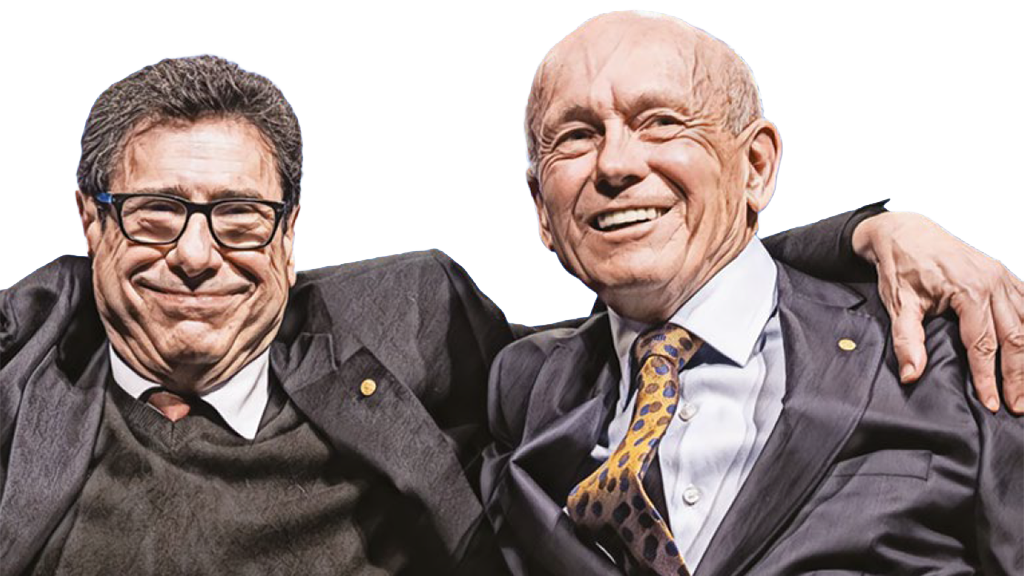
One of the wonderful things about Philippe is his boundless enthusiasm
A version of this article was first published by the European Economic Association.
John Van Reenen is the Ronald Coase Chair in Economics and School Professor at LSE, former CEP director and director of the Programme on Innovation and Diffusion.
Discover Philippe Aghion's recommendation for a must-read paper here.
20 February 2026 Paper Number CEPCP722
Download PDF - Philippe Aghion: explaining sustained growth through creative destruction
This CentrePiece article is published under the centre's Growth programme.
This publication comes under the following theme: Innovation drivers