
Back pages: In numbers
Teachers are at their strictest in middle age
Etienne Dagorn, Isaac Parkes and Alberto Prati

Two teachers grading the same pupil can reach very different conclusions. Our study explores the extent of grading bias due to systematic differences in teachers' grading styles - their relative leniency. This relates to the "inner yardstick" that a teacher uses to map performance to grades.
To investigate how leniency varies between groups of teachers we use a large-scale online experiment in which more than 1,600 French secondary school teachers independently evaluate the same set of fictitious student transcripts, generating hundreds of ratings per transcript.
As there is no "correct" evaluation for these transcripts we use the mean of the many independent assessments as the relevant reference point and define leniency in terms of how teachers' grades differ from this point.
We find two characteristics associated with leniency. First, teachers with a higher level of altruism tended to be more lenient. Second, grading styles follow a pronounced U-shaped pattern with age: middle-aged teachers are systematically less lenient than both their younger and older colleagues (Figure 1).
Figure 1: Grading style as a function of age
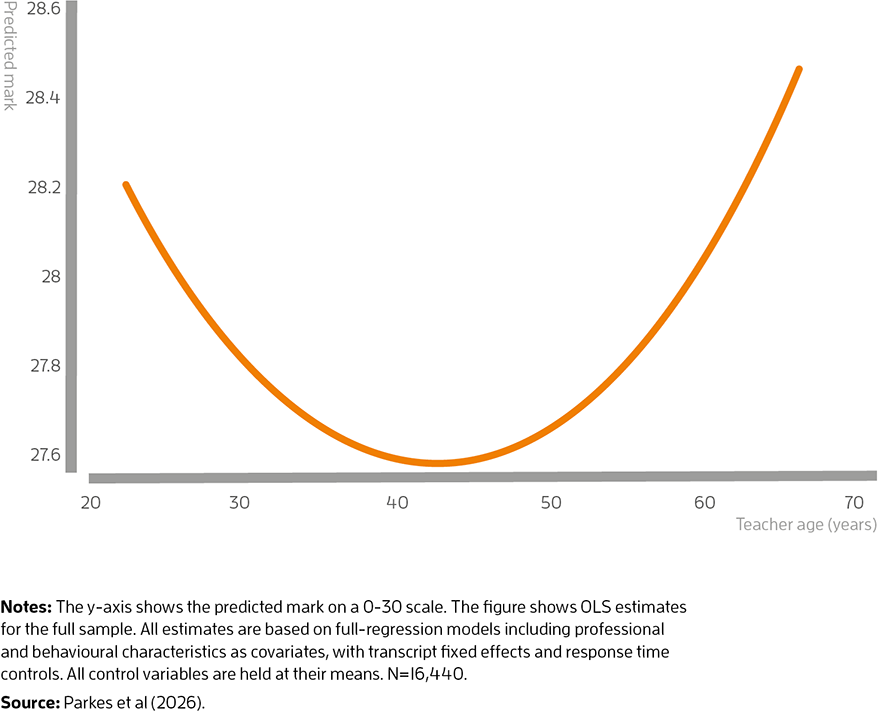
This suggests that a pupil evaluated by a 40-year-old teacher receives a lower grade than the same pupil evaluated by a 60-year-old teacher, and the effect is comparable in magnitude to documented gender biases in mathematics grading.
In an educational context, a natural policy response to this would be to rely on age-diverse committees, which combine mid-career teachers with junior and/or senior colleagues.
Read the full paper: Dagorn, E., Parkes, I. and Prati, A. (2026) Teachers' leniency: experimental evidence. CEP Discussion Paper No. 2204.
Etienne Dagorn is an assistant professor at the University of Lille. Isaac Parkes is a research assistant in CEP's wellbeing programme and a PhD candidate at King's College London. Alberto Prati is an assistant professor of economics at University College London and a research associate in CEP's wellbeing programme.
20 October 2026 Paper Number CEPCP752
Download PDF - Teachers are at their strictest in middle age
This CentrePiece article is published under the centre's Education programme.