
Behind the news: Trade
Tariff confusion
Kalina Manova, Dennis Novy, Thomas Sampson and Aaron Tang
The way that US tariffs were announced doubled their negative impact
In 2025, there was a series of major changes in US trade policy. From new steel and aluminium duties to "fentanyl" tariffs on China and "Liberation Day" tariffs covering almost all trade partners, the year was unprecedented in the frequency, complexity and volatility of policy interventions. Between February and December 2025, 53 announcements introduced, delayed, reinstated or changed tariffs.
Overall, these announcements led to higher tariffs, and it is well established that tariff increases reduce trade. But did the capriciousness with which policy changes were announced and implemented lead to additional trade disruption? Our new research provides evidence that it did.
Frequent, complex revisions make it harder to keep track of tariff levels. We find that tariff confusion about the current state of US tariff policy led to significant declines in US imports during 2025.
Strikingly, we estimate that the fall in US imports due to tariff confusion was similar in size to the reduction caused by tariff increases alone, meaning that confusion doubled the negative impact of tariffs. These results illustrate previously unexplored consequences of the manner in which trade policy changes are introduced.
What is tariff confusion?
Periods of frequent and complex policy announcements require firms continuously to monitor and process the arrival of new information. This information problem becomes more difficult as announcements accrue over time.
Tariff confusion then arises if firms miss an announcement; are unsure which origins and products it affects; or struggle to determine how it changes the prevailing tariff rate. While distinct from uncertainty about hypothetical future tariffs, confusion can be seen as a manifestation of trade policy uncertainty in real time.
The reactions of business to policy announcements during 2025 revealed rising confusion as firms struggled to keep abreast of the latest changes. "Tariffs mean an economic hit for US firms - but also confusion", reported Fortune magazine in April. "Confused and concerned, CEOs get to grips with [the] new tariff regime [and] a new era of tariff complexity", flagged CNBC in August, quoting Oliver Bate, CEO of German insurance giant Allianz: "If you are not confused, I don't know what confuses a human being."
Measuring tariff confusion
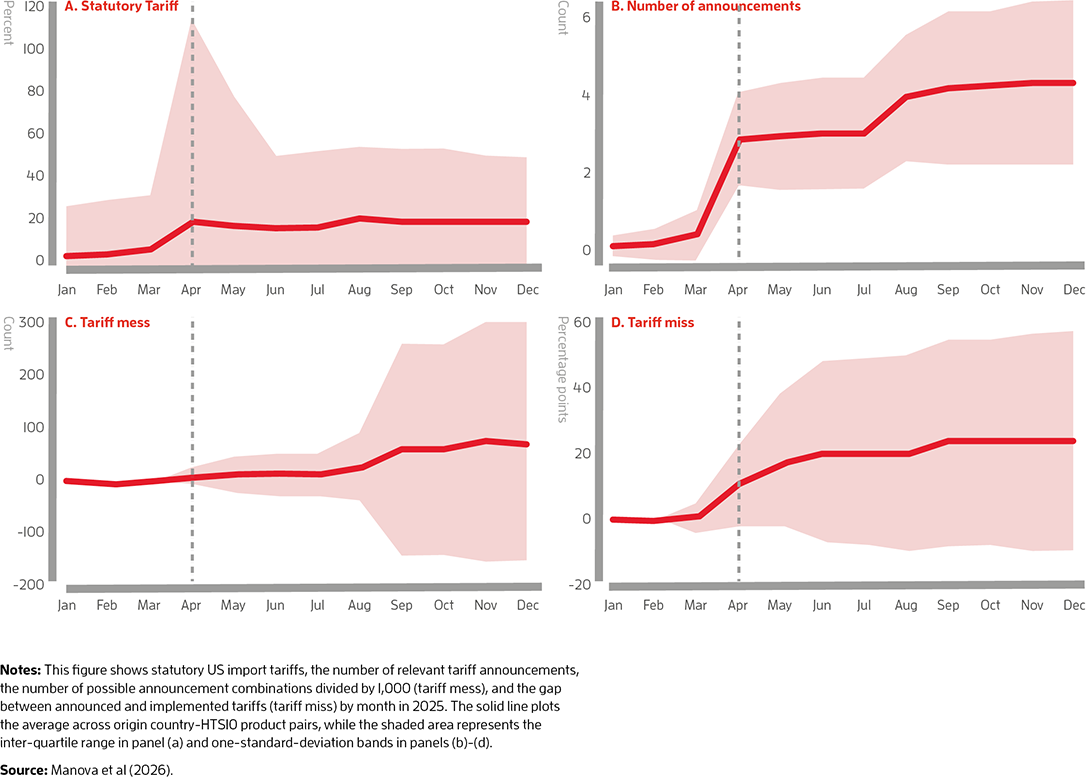
To study confusion formally, we construct a new US Tariff Announcement Database (USTAD). The database tracks all US trade policy announcements made via presidential executive orders and proclamations in 2025. The 53 announcements in USTAD led to 1.45 million changes to tariffs on origin-product pairs with positive US imports in 2025. Of these changes, 1.05 million were tariff increases, while 0.39 million were decreases.We use USTAD to calculate the statutory import tariff and four indicators of potential tariff confusion for each origin country, product, and month. Our four indicators of tariff confusion are: the cumulative number of policy announcements that affect a given origin-product pair; the number of possible announcement combinations firms need to track (tariff mess); the highest tariff across all relevant announcements (tariff max); and the gap between this highest tariff and actual tariffs (tariff miss).
The statutory tariff and all our tariff confusion measures increased sharply during 2025 with considerable variation across origin country-product pairs. Figure 1 shows the tariff rate and three of these indicators.
Figure 1: US statutory tariffs and tariff confusion: January - December 2025
How tariff confusion affected US imports
We make use of the variation in statutory tariff changes and tariff confusion across products, origin countries and months during 2024/25 to analyse the trade effects of US policy changes. Our analysis disentangles the impact of tariff confusion from the consequences of higher statutory tariffs.
We find that both higher tariffs and greater tariff confusion significantly disrupted US imports in 2025. A 10% higher tariff reduced monthly imports by 3.3%-4.9% on average across countries and products. Conditional on the tariff, each additional tariff announcement lowered imports by another 3.0%.
Our estimates imply that higher US tariffs reduced US imports in December 2025 relative to December 2024 by 4%-6% for the average origin country-product pair. Cumulative tariff confusion caused an additional 7%-12% fall in imports. This additional fall would not have occurred if tariffs had been raised once and for all in a clear policy statement.
The reductions in US imports caused by higher tariffs and tariff confusion both occurred primarily through lower import quantities, with little or no effect on pre-tariff import prices. We also find that the impact of tariff confusion was persistent throughout 2025 and was more damaging at higher tariff levels.
Notably, the reduction in US imports due to tariff confusion was smaller for products that tend to be more customised or have stickier buyer-supplier relationships. Imports from countries with greater trust in foreigners were also less affected. These findings are consistent with product customisation, relationship trust and partner reputation enabling firms to maintain trade activity during information shocks.
The paper's findings show that the consequences of trade policy changes depend on how the changes are implemented. A single, unambiguous policy statement is less disruptive than repeated, complex announcements. Our results imply that the drop in US imports caused by the 2025 tariffs would have been around 50% smaller if there had been no confusion about US tariff policy.
The value of information transparency highlights the importance of the design of the trade policy process. Monetary authorities have long recognised the value of transparency and predictability. Perhaps these values should also guide trade policy institutions.
This article summarises Manova, K., Novy, D., Sampson, T. and Tang, A. (2026) Tariff confusion. CEP Discussion Paper No. 2195. An earlier version first appeared on LSE United States Politics and Policy.
Kalina Manova, is a professor of economics at University College London and a research associate in CEP's trade programme. Dennis Novy is a professor of economics at the University of Warwick and a research associate in CEP's trade programme. Thomas Sampson is an associate professor of economics at LSE and a research associate in CEP's trade programme. Aaron Tang is a PhD student at University College London.
20 October 2026 Paper Number CEPCP744
Download PDF - Tariff confusion
This CentrePiece article is published under the centre's Trade programme.