
Back pages: In numbers
Anatomy of automation
Aniket Baksy, Daniel Chandler and Peter Lambert
The effects of automation on employment may be less severe than often feared, but some workers are more at risk.

We analyse how increased use of computer numerical control (CNC) machines affected employment in UK manufacturing plants between 2005 and 2023. CNC machines are programmable tools that cut, drill or shape materials (typically metals) into precisely defined components.
Figure 1: Employment effects of adopting or expanding computer numerical control (CNC) machines
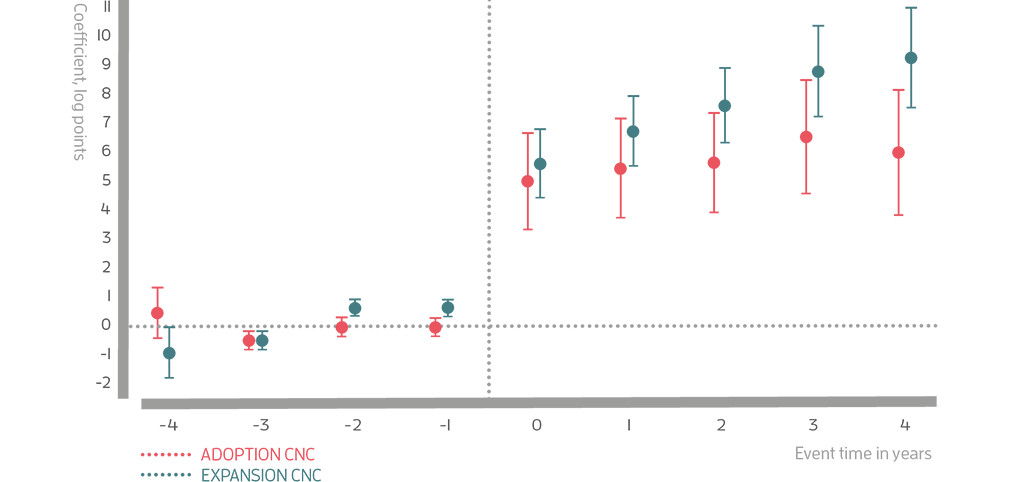
Figure 1 shows that plants adopting CNC machines for the first time increase their total employment by about 6% over the subsequent four years, compared with non-adopting plants in the same industry. For firms already using CNC machines, expanding the number of them is associated with an even larger increase in total plant employment than initial adoption.
Figure 2: Share of manufacturing employment after adoption or expansion of computer numerical control (CNC) machines
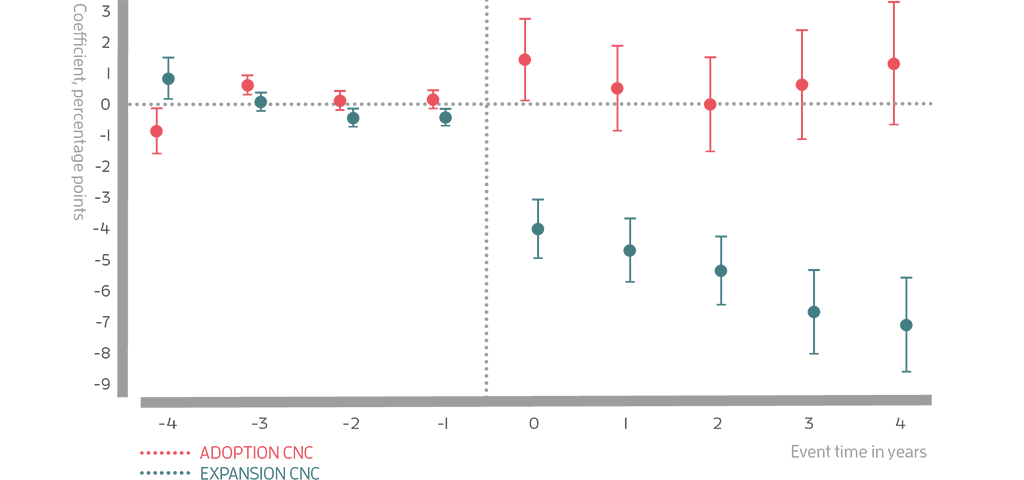
Figure 2 illustrates the impact on different types of jobs, plotting the share of manufacturing production workers in total employment across manufacturing production workers, designers and engineers. Initial adoption has little effect on this share, but the expansion of CNC machines leads to a notable decline - of around 8 percentage points after six years. One possible explanation is that as firms gain experience with given technology, they reorganise production processes in more transformative ways.
Read the full paper: Baksy, A., Chandler, D. and Lambert P. (2025) Anatomy of automation: CNC machines and industrial robots in UK manufacturing, 2005-2023, CEP Discussion Paper No. 2131.
Aniket Baksy is a senior lecturer in economics at the University of Melbourne. Daniel Chandler is research director of the Programme on Cohesive Capitalism at LSE and a research associate in CEP's labour programme. Peter Lambert is a research fellow at the University of Warwick and a visiting fellow in CEP's growth programme.
20 February 2026 Paper Number CEPCP730
Download PDF - Anatomy of automation
This CentrePiece article is published under the centre's Labour programme, Growth programme.