
Back pages: In numbers
Working from home in the public sector
Alessandra Fenizia and Tom Kirchmaier
Study finds workers work faster when they work from home

The number of employees in the private sector who have working from home (WFH) arrangements has risen sharply since the pandemic. Our research studies WFH in a public sector organisation where pecuniary incentives are typically not allowed and workers have strong job security – allowing us to provide causal evidence of the effect of WFH on workers’ productivity independent of incentives.
We use the records of the crime recording and resolution unit of the Greater Manchester Police, which records details of cases from emergency and non-emergency calls. Police staff follow a rota which sets out which days they WFH and work from the office (WFO).
Figure 1: Individual differences in productivity when working from home
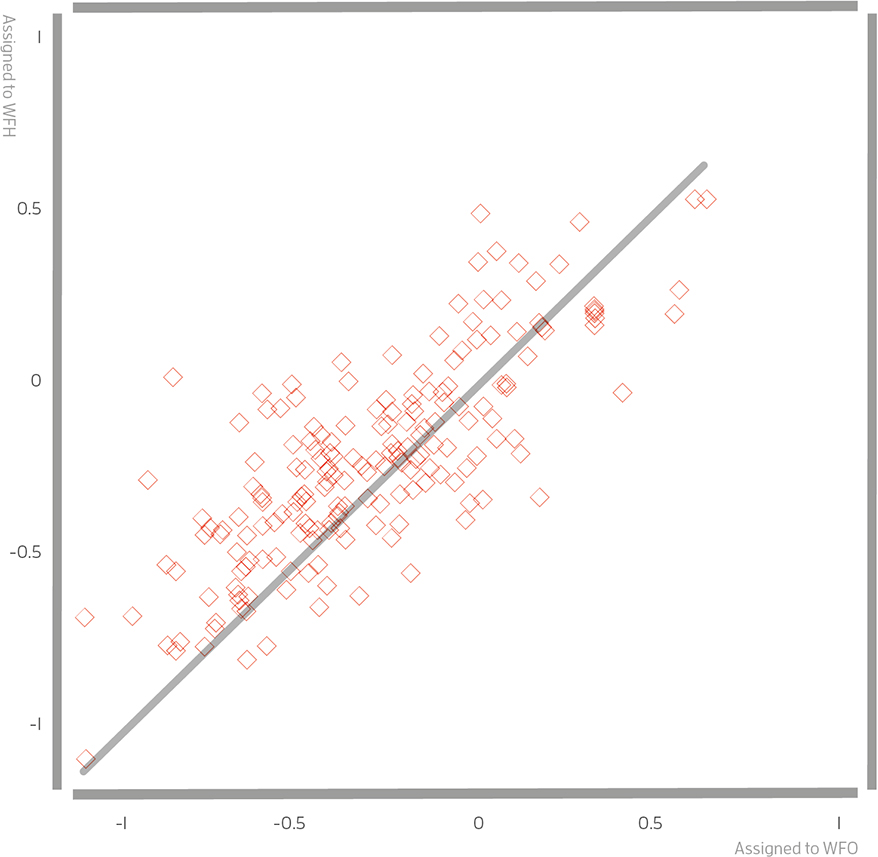
Our analysis shows that when the workers are assigned to WFH, they record between 9% and 10% more cases per day. As WFH is unlikely to suit everyone equally, we also estimate individual-level effects. The figure shows the estimated worker effects when assigned to WFH vs WFO. If all workers were equally productive under these two working arrangements, all diamonds would lie on the 45-degree line. Three patterns stand out. First, workers who are highly productive at home are also highly productive at the office. Second, there are big differences in how productive workers are even within the same arrangement. Third, most workers are more productive when assigned to WFH than WFO, shown here by most diamonds being above the 45-degree line.
We find WFH increases workers' productivity by 12.2% and does not affect the total time spent recording cases. The increase in productivity is primarily explained by the fact that workers work faster when they WFH.
Read the full paper: Fenizia, A. and Kirchmaier, T. (2025) Not incentivized yet efficient: Working from home in the public sector, CEP Discussion Paper No. 2036.
Alessandra Fenizia is an assistant professor of economics at the George Washington University. Tom Kirchmaier is director of CEP's policing and crime research group.
19 June 2026 Paper Number CEPCP740
Download PDF - Working from home in the public sector
This CentrePiece article is published under the centre's Crime programme.