
Behind the news: Wellbeing
Spending public money to create happier lives
David Frayman, Christian Krekel, Richard Layard, Sara MacLennan and Isaac Parkes
Choosing policies that most improve wellbeing would radically change government priorities. David Frayman, Christian Krekel, Richard Layard, Sara MacLennan and Isaac Parkes explain the science behind the new approach.
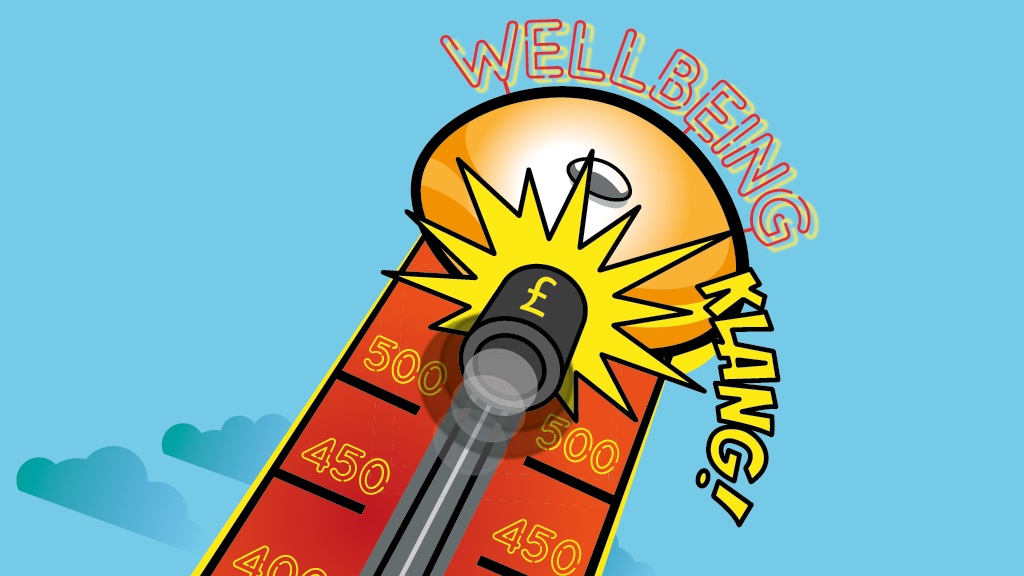
In the coming spending review, the UK's new government will be allocating around £1tn a year to be spent on our behalf. How do we want the money spent?
We believe it should be spent to improve people's wellbeing and to reduce the prevalence of misery. This means that every policy should be judged by the wellbeing benefits it provides per pound spent. In theory this already happens. Legions of economists estimate benefit/cost ratios, at least for new proposals. But two things need changing.
First, these calculations need to be given much more weight when decisions are made. And second, the calculations need to include all the non-economic factors that affect people's wellbeing - such as having a job, better health and crime-free streets. The Treasury Green Book on policy appraisal now says this, but it happens far too rarely.
That could be about to change. Keir Starmer has said: "With every pound spent on your behalf we would expect the Treasury to weigh not just its effect on national income but also its effect on wellbeing."
In our recent report we spell out how this should be done. And then we give worked examples across the whole f ield of government to show how this would affect priorities. We really hope that this will be the approach in the coming spending review.
Measuring wellbeing
The first issue is the measurement of benefits. Our preferred measure (and indeed most other researchers') is life satisfaction - how satisfied people are with their lives. This is the first question asked in the regular wellbeing surveys conducted by the UK's Office for National Statistics: "Overall, how satisfied are you with your life nowadays?" (on a scale of 0 to 10, where 0 means not at all). Respondents answer this question quickly. But do their answers provide serious information that can be compared across people and over time?
One test is whether they predict observable behaviours. They do. They predict whether a person will be alive in 10 years' time about as well as a medical diagnosis does (Steptoe and Wardle, 2012). They also predict productivity and quitting (De Neve et al, 2013; Bellet et al, 2023).
Most importantly, they predict how well the government will do in a general election (Ward, 2020). In fact, they predict this better than the state of the economy does. So it's not "the economy, stupid"; it's more like "wellbeing, stupid". This is important because it gives policymakers every reason to promote wellbeing - even if only in the interests of remaining in power.
As a measure of wellbeing, life satisfaction has the huge merit of being democratic. It is left to individuals to evaluate their own wellbeing. There is no expert deciding which are the most important indicators on a dashboard. We simply ask: "Overall, how satisfied are you with your life nowadays?"
For a government policy, what matters is how it affects those answers and for how long. So the measure of benefit is years of wellbeing change (or "wellbeing years"). Future changes have to be discounted but only slightly (the Treasury Green Book uses 1.5% per annum).
Every policy should be judged by the wellbeing benefits it provides per pound spent
Estimating the benefits of policies
The science of happiness is now good enough for us to take a good shot at calculating these benefits. This does not mean throwing away traditional benefit/ cost analysis, where the benefits typically included income gains plus other nonincome benefits where they could be valued by what people would be willing to pay for them. The problem, however, was that it was often impossible to estimate what someone would be willing to pay - for better health or for getting a job or living in a crime-free environment. By contrast, wellbeing science gives us direct evidence on how such non-income changes affect wellbeing.
So in the new approach we have to combine effects on income (measured in pounds) with effects measured in wellbeing years. This is easy because we know how income affects wellbeing years. Using this information we can convert money into wellbeing years or wellbeing years into money. The Treasury Green Book recommends turning wellbeing years into money and that is what we do in the report. That gives us our measure of benefits.
Estimating the net cost of policies
The next key issue is how much it costs to produce the benefits. For most policies the net cost is different from the gross cost because the policy, once implemented, also affects future public sector costs. For example, treating mental illness now enables many patients to work, paying taxes and coming off benefits. The benefit/cost ratio So finally we have got to the measure by which we want all policies to be judged (alongside other qualitative, nonquantifiable arguments). That measure is
Wellbeing benefits (in £s)
Net cost (in £s)
or the benefit/cost ratio (BCR). This is a simple logical point. If the aim of the budget is to maximise the nation's wellbeing, then policies should be valued by their BCRs and those with higher BCRs adopted, up to the point when the budget is exhausted. That would be the mark of rational government.
Some examples
This approach was spelt out in detail by our colleagues Paul Frijters and Christian Krekel in their 2021 handbook, and then encouraged in the Treasury Green Book revision in 2021. The time has come to apply it and in our report we apply it across the range of government policies. Figure 1 shows our results.

The most obviously desirable policies are those which cost nothing - because they save more than they cost. NHS Talking Therapies are like that. They help enough people into work and off benefits to pay for themselves within two years. They are a no-brainer.
But NHS Talking Therapies only cover anxiety disorders and depression. They do not cover addiction to alcohol, drugs or gambling - conditions that wreak havoc on the lives of the sufferers and their relatives, and which cause high levels of economic inactivity. A new service for them would pay for itself within two years.
Government exists to improve the wellbeing of the people
Similarly for children, the mental health support teams in schools service pays for itself within two years but it currently covers only one-third of the country.
Regulatory reform is another policy that costs nothing but can produce major benefits. If we want more housing, the simplest way is to designate as grey belt, land within 800 metres of commuter stations as building land, unless it has a clear amenity use.
But, most government policies do cost money and there the key issue is their benefit/cost ratio. Of the policies that we investigated, four had benefit/cost ratios above 10:1. They were: wellbeing lessons in schools, research and development tax credits, more police, and guaranteed access to apprenticeships. For people who do not go to the university, an apprenticeship is the main route to a skill. But there are far too few apprenticeships to meet demand (on the government's current matching scheme three times as many people want places as the number of places on offer). The effect is a mass of low-skilled workers, low productivity and low pay. While at age 15 our young people perform as well as those in France and Germany, by 25 we have a longer tail of low skill. Since skill is in short supply, it commands a premium - one reason why the benefit/cost ratio is so high. So there is every reason why the government should commit to ensuring that every qualified applicant for an apprenticeship can find a place.
Though the policies mentioned in the last paragraph produce large benefits, they also have costs. To finance them we have to consider cutting expenditures with much lower benefits. (That is the essence of the process of maximising wellbeing from a given budget). We found a number of policies had benefit/cost ratios of three or less: the existing road programme, the proposed Lower Thames Crossing, HS2, the winter fuel allowance (except for benefit recipients) and teacher/pupil ratios in schools. We also studied the implications of raising the state pension age to 68 earlier than 2046 (as planned). The age was last raised just before the pandemic and we can estimate the loss of wellbeing which that caused. It was not large (0.12 points out of 10). And the saving to the budget was £6bn. So the benefit from delaying the rise to 68 is a measly BCR of 0.2.
These findings are just examples of a method. They show two things:
- The method is operationally feasible (and is not that different from the quality adjusted life year method used in the NHS).
- The results show the need for major reallocations of money.
We hope that in the 2025 spending review the Treasury will require departments in their bids to show the estimated BCRs for their major expenditures - current as well as capital.
Reducing misery
Finally, the hugely important issue of misery. The key issue is this: do we care more about raising the wellbeing of people who are miserable than we do about raising the wellbeing of people who are already happy? Many politicians do care more about misery. So how does this affect our analysis?
We do not suggest altering the criteria already set out. But we should attempt to break down the benefits into those accruing to different groups with differing levels of initial wellbeing. We should also encourage ministers to search for new policies most assiduously in areas that improve low wellbeing.
Conclusion
Government exists to improve the wellbeing of the people. Indeed, in the words of US founding father and third president Thomas Jefferson: "The life and happiness of the people is the first and only object of good government."
Because of the new science of wellbeing, we are now much better placed to implement this approach. We can measure wellbeing, and we can estimate how different policies will affect wellbeing and how much they cost. So a government can now scrutinise all its possible policies and have evidence, however rough, on how cost-effective its different activities are. And the measure of cost-effectiveness is the ratio of benefit to cost.
It is in politicians' interest to take such calculations seriously. So let us hope that the benefit/cost ratio approach that we propose can become a central feature of the next spending review. If this were done, the UK would be the first country in the world to have such a rational system of public expenditure planning. It would be an example to the world.
Many mental health initiatives have no net cost: indeed, they save the government more than the original cost
18 October 2024 Paper Number CEPCP687
Download PDF - Spending public money to create happier lives
This publication comes under the following theme: Targeting policy at wellbeing