
The economic costs of the failing planning system
Paul Cheshire began to investigate the economic effects of the UK?s planning system 40 years ago. Here he draws on a recent public lecture ? and panel discussion with Stephen Aldridge, Kate Barker and Simon Wolfson ? to explain how two generations of failure to build enough houses have led to considerable damage to employment, productivity and equality.

Only about a third of those born in the 1980s became homeowners by 30, compared with more than half of their parents' generation
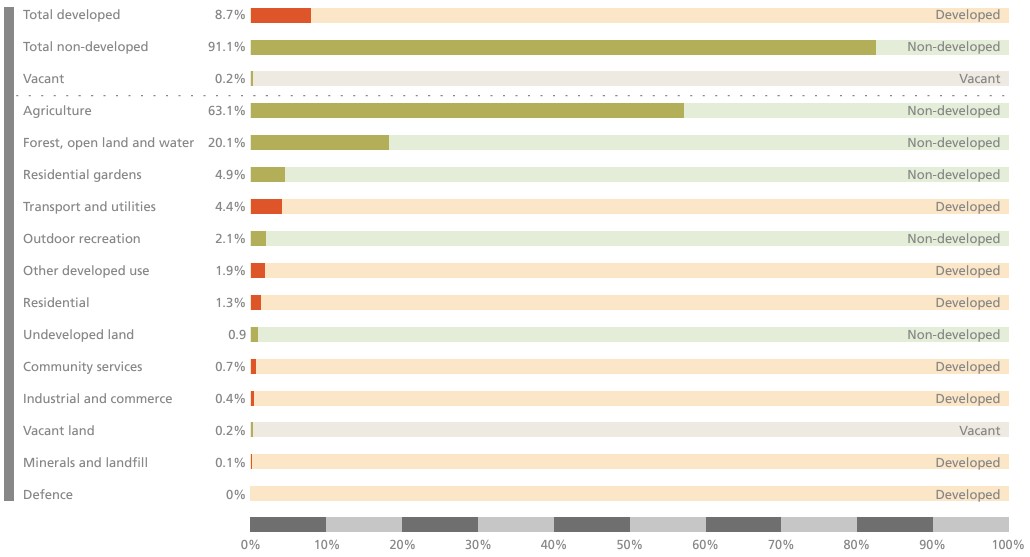
It is a surprise to most people to discover that less than 10% of England - much less for the UK as a whole - is "developed". Around half of this developed land is given over to transport and utilities; and around half consists of buildings. Since residential houses make up about a quarter of these buildings (see Table 1), they are a hugely important focus of land use planning.
There is a growing housing affordability crisis in the UK. House prices have increased by almost two and half times as much as average incomes over the last 25 years. For those born in the 1950s, 55% owned a house by the age of 30; of those born in the 1980s, only about a third did so (Broome et al, 2022) - this is a huge source of inequity between the old and the young, seriously damaging social cohesion.
The problem underlying that problem is supply restriction, primarily via our planning system.
From the mid-19th century until the second world war, we built railways, the tube system and roads - meaning that, as cities grew bigger, the supply of land expanded to accommodate growing demand. Then in 1955, green belts were imposed. These restricted land supply in exactly those areas - around our large cities - where demand was strongest, and led to a huge increase in the cost of housing.
While house prices increased fivefold in real terms between 1955 and 2008 (Cheshire, 2009), the price of land for putting houses on increased 15-fold over the same period. The result of that is smaller houses, worse design and poorer construction, because all the money in housebuilding has to go on the land.
And it's not just an issue of land supply: it's also that we have a discretionary planning system that injects uncertainty into the development process. So what does this mean for housing supply?
The Centre for Cities has calculated that compared with the average European country, we have a shortfall of 4.3 million houses since 1945.
Adapting green belts
I have two possible suggestions for improving the situation - things that could be done at zero cost and which would improve the situation considerably.
First, adapt green belts to serve green purposes. Identify and preserve amenity or environmentally rich land - we don't want to build over vast tracts of the countryside that are beautiful or that people benefit from: but then permit development on land with no amenity or environmental markers within 800m of commuter rail stations.
Second, it is expensive to have a discretionary system: moving to a rulebased system would reduce uncertainty and risk, increase competition and help smaller builders.
Table 1: Amount of land, by land use group.
Dame Kate Barker, whose 2006 land use planning report identified the need to increase certainty and reduce delays in the system, perhaps formulated the fundamental point most sharply. Planning is centrally concerned with the most basic of economic functions: the allocation of scarce resources - in this case land and buildings, for different purposes. But it operates in a parallel, non-economic, universe in which planners know what we "need", supply is not supposed to influence prices and demand is unaffected by incomes. Moreover, both location and time are implicitly assumed to be costless.
At our LSE event, she queried the use of the concept of "housing need" in the planning system as a way of allocating land for housing. It is supposed to be based on forecasts of future household numbers in a locality. But, of course, the actual number of households that appear (either through formation or by moving into an area) is itself a function of how many houses are built. Improved local housing access means that more people leave home to form joint households; and more people looking for work will be able to move to the area.
Rent and housing costs are simply prices - and prices are determined by the interaction of supply and demand. Yet housing demand is influenced not only by the number of households but by their composition, the prices of other goods such as cars (the use of which requires space) and above all, the evidence indicates, by income (Cheshire, 2018).
A discretionary planning system increases the risk of development, resulting in many potentially viable projects not even being pursued
Generational divide
Stephen Aldridge highlighted the generational divide that this has created. In his talk he pointed out that in 1997, the ratio of median house prices to earnings was 3.5 in England; in 2022, it was 8.3, and in some parts of the country the changes are even greater. In London, for example, the ratio increased from four to 12.5 over the same period.
Reflecting this deteriorating affordability, over the past 20 years the overall rate of home ownership has fallen to 64% from a peak of 71%, favouring older, established homeowners compared with the young, so that in the past decade there have been more outright homeowners than owners with a mortgage.
Simon Wolfson, chief executive officer A discretionary planning system increases the risk of development, resulting in many potentially viable projects not even being pursued Stops on shops of the retailer Next, claimed there was a wider problem, suggesting that we should even stop calling the system we have "planning" because, as he said: "Something as complex, as difficult, as where 65 million people live, work, shop, enjoy their leisure time, something as complex as that cannot be planned top down. It's as simple as that.
"Planners do not have the right incentives. They don't have the right knowledge. They're not able to … innovate, experiment, try new things in a way that a proper vibrant evolutionary market can. And, of course, they constantly suffer from political interference."
Wolfson claimed that time in economic activity is money: time is a scarce economic resource. The complexity and politicised nature of our planning system means that it takes substantially longer to get planning permission for a new warehouse than it does to build it.
Stops on shops
All decisions about development in the UK system are "discretionary". The decisions are made by the local planning committee. If the proposal fails, the application may go to appeal. That takes time and expensive specialist planning lawyers and consultants. A discretionary system also injects uncertainty so increases the risk of development. More risk means that to be viable there must be a higher expected rate of return meaning that many projects that might be viable if it was clear from the outset whether they could be built or not, end up not even being applied for.
House prices are economic realities determined by demand and supply, not by planning fiat. Demand is influenced mostly by potential buyers' incomes, but planning is still very influential in determining supply.
And it's not just housing that suffers, research I have carried out with Christian Hilber and Ioannis Kaplanis (Cheshire et al, 2015) quantified the loss of total factor productivity caused by the Town Centre First Policy, which required all new establishments serving "traditional town centre activities" - primarily shops - to locate on sites selected by planners. We got all the data for a large supermarket chain and estimated a production function for its stores including land (floorspace) as well as the usual labour and capital inputs. Comparing stores in England with those in Scotland and Northern Ireland where the Town Centre First Policy was introduced later and was much less rigid, showed the policy caused a total loss of productivity of 32%.
This was not just because town centre stores were smaller but also because retailers seemed to have been forced onto intrinsically less productive sites with poorer layout and access for both customers and logistics.
'Housing need' in the planning system is supposed to be based on forecasts of future household numbers – but the actual number of households that appear depends on how many houses are built
More recently - and not published beyond conference papers - a similar exercise was done for a major clothing retailer. Here the hit to total factor productivity of Town Centre First Policies was a really large 47%: not only were the stores' locations and site configurations intrinsically less productive but their smaller size caused an even bigger hit to productivity than was the case for supermarkets (Cheshire et al, 2012).
Not only that, but decisions can be influenced by lobbying and that is a deadweight economic loss. In London, where there are constraints on office development mainly from height controls, we have shown (Cheshire and Dericks, 2020) that by employing an expensive "trophy architect" (an architect who has won one of the three main lifetime achievement awards) developers can game the system to get an extra 14 floors on their offices (providing the site was not in a strictly height-controlled location such as a conservation area). Allowing for the extra construction costs of such buildings, this implied capturing a £148mn "rent" for a representative site. A £148mn "rent" which is equally a measure of the deadweight loss entailed in having such a gameable, but expensive to game, discretionary system.
20 June 2024 Paper Number CEPCP680
Download PDF - The economic costs of the failing planning system
This CentrePiece article is published under the centre's Community Wellbeing programme.