
Research: Productivity
Finding meaning at work
Nava Ashraf, Oriana Bandiera, Virginia Minni and Luigi Zingales
Helping employees assess their jobs through the lens of purpose increases productivity and narrows gender gaps in career choices

Since the industrial revolution ushered in factory working, there has been a rapid rise in the size of workplaces. Tesco, the British supermarket giant, has more than 330,000 employees and Walmart, an American retail corporation, has around 2.1 million employees across the world. While the industrial revolution sparked high global GDP growth and productivity, the shift to larger workplaces has also created distance between workers and the fruits of their labour, reducing motivation and productivity. Understanding how to make work meaningful is one of the pillars of the LSE’s Altruistic Capital Lab, a community of researchers, policymakers and firms who use state-of-the-art theory and statistical methods to design and evaluate solutions for the workplace of the future.
In a recent project (Ashraf et al, 2025), we evaluated one of our partner firms' attempt at guiding their employees to find meaning at work through a worker-centred "Discover Your Purpose" (DYP) intervention. The firm was a large multinational company with more than 127,000 employees. We randomised the intervention's roll-out among 2,976 white-collar employees and evaluated its impacts on the annual exit rate, employee performance, pay and general wellbeing using the firm's administrative data and our own surveys.
The importance of purpose
The DYP intervention involves a combination of readings, essays and a workshop drawing from the practice of logotherapy, developed by neurologist and psychiatrist Viktor Frankl. This emphasises the idea that everyone's primary motivation in life is a search for meaning. DYP consists of two parts, with the workers first independently completing a briefing pack and then attending a day-long workshop run by internal facilitators.
The briefing pack includes self-reflection exercises in which workers are prompted to examine their life experiences. In the workshop, participants use stories from their life to reflect on their experiences and find a common theme, which becomes their purpose statement. Employees are asked to assess their jobs in terms of this statement. Tasks have low meaning when they do not advance what the worker perceives as significant or worthwhile, and a strong sense of purpose decreases the cost of effort for the worker.
Following the intervention, those who find less meaning at work are more likely to feel their pay no longer compensates and therefore leave
Research has shown that productivity improves when workers' efforts are going towards a cause that they believe in. Purpose refers to the person's unique personality traits shaped by their life experiences and determines what they enjoy doing or what makes them unhappy.
More workers quit and more get bonuses
We find that, while taking part in the DYP intervention increases the average yearly exit rate by 5.1%, the share of employees who perform below expected standards, drops from 10.4% to 5.3%. This is split between workers who either leave the firm or improve their performance following the intervention, and results in a higher share of employees receiving bonuses following the departure of low performers.
Figure 1: Intervention flattens the money-meaning curve
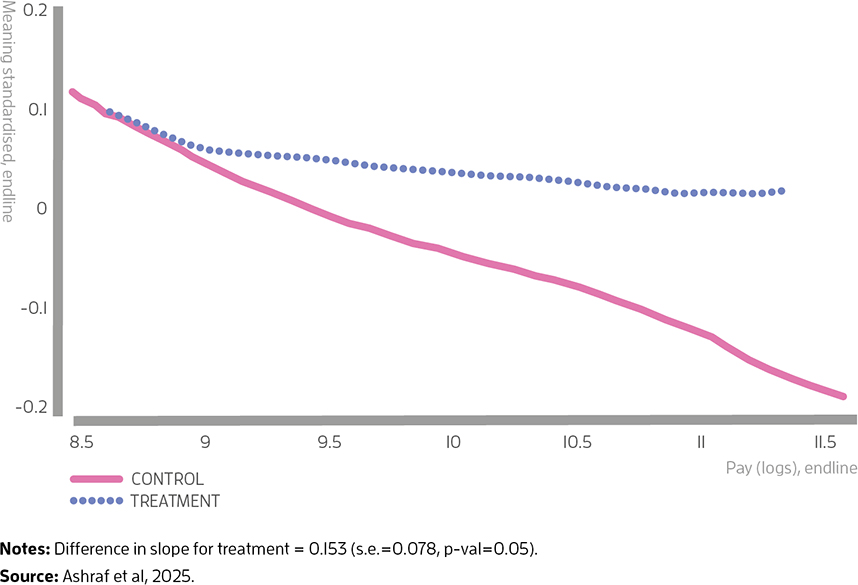
Figure 1 shows, for every level of meaning, the average pay that workers with that level of meaning are willing to accept to work for that firm. The solid line slopes downwards as those who derive less meaning require higher pay. But the money-meaning frontier for those in the treated group, as shown by the dotted line, is higher because the intervention increases the weight placed on meaning. This implies that those who find less meaning at work are more likely to feel their pay no longer compensates and therefore leave. Indeed we find that exits are concentrated among employees with high pay and low performance.
Shrinking gender gap preferences
DYP also saw employees defy gender expectations. Gendered norms are deeply ingrained aspects of socialisation and can dictate behaviours of men and women in the workplace, impacting parental leave, work-life balance and leadership expectations. In our control group, men were more likely to rank "high prestige" as a top priority, while women ranked "flexible time" and "work-life balance".
Following the intervention, gender gaps shrunk in nine of 12 dimensions relating to prestige, job security, flexible time, high income and opportunities for advancement. And the importance of a work-life balance decreased for both genders as workers were more likely to see where their personal goals aligned with the firm's tasks, bringing "life" into their work.
Gendered norms are deeply ingrained and can affect workplace behaviour
Similarly, DYP prompted a shift in workplace behaviours as men who were assigned to take part in it were 1.3 percentage points more likely to take parental leave compared with controls. By participating in DYP, our findings indicate that both men and women were more likely to examine their preferences in terms of their individual purpose rather than relying on imposed assumptions.
Worker satisfaction, success and incentives
Employees who remain after the intervention report higher levels of meaning, job satisfaction and overall life happiness. This suggests that DYP helped workers realise how their job contributes to their purpose (or not). Taken together, these findings indicate that DYP-treated workers who remained were both more productive and happier in their jobs.
However, DYP is no silver bullet as it relies on a pre-existing culture of trust in the firm. Trust is essential for employees to be willing to share personal stories and to respond to treatment expecting its gains to be shares. Especially as workers grew more productive following the intervention, and earned more financial bonuses, credibility as a firm is necessary to ensure that the greater alignment of those who remain is not exploited.
When working harder directly leads to better outcomes, monetary incentives are a fair and effective means to good performance
This intervention also highlights an interesting phenomenon - why do firms keep relying on monetary incentives for employees? One reason could be that people systematically overestimate how much their individual effort determines their outcomes. When we believe that working harder directly leads to rewards, monetary incentives are a fair and intuitive result for good performance.
In reality, outcomes under large organisations are produced based on the efforts of many other people in the company, whose contributions we tend to underestimate. And they depend on factors that are outside of individual control, like luck or timing constraints.
As a result, monetary incentives reward individual workers for results that are produced collectively and influenced by chance. This is where DYP can motivate workers even as monetary incentives fall short, through enabling employees to shape their roles with inherent purpose and factors available to them, or to leave the firm if they determine that they cannot do so.
An earlier version of this article appeared on LSE Business Review.
Nava Ashraf is a professor of economics at LSE and director of the Altruistic Capital Lab. Oriana Bandiera is the Sir Anthony Atkinson Professor of Economics at LSE. Virginia Minni is an assistant professor of economics at the University of Chicago Booth School of Business and a research associate in CEP's labour programme. Luigi Zingales is the Robert C McCormack Distinguished Service Professor of Entrepreneurship and Finance at the University of Chicago Booth School of Business.
Further reading
Ashraf, N., Bandiera, O., Minni, V. and Zingales, L. (2025) Meaning at work. CEP Discussion Paper No. 2104.
19 June 2026 Paper Number CEPCP736
Download PDF - Finding meaning at work
This CentrePiece article is published under the centre's Labour programme.
This publication comes under the following theme: Gender in the labour market, Work and wellbeing