
Research: Rare earths
Cleaner energy, higher risk?
Gavin Harper and Viet Nguyen-Tien
Why critical materials are central to global strategic partnerships
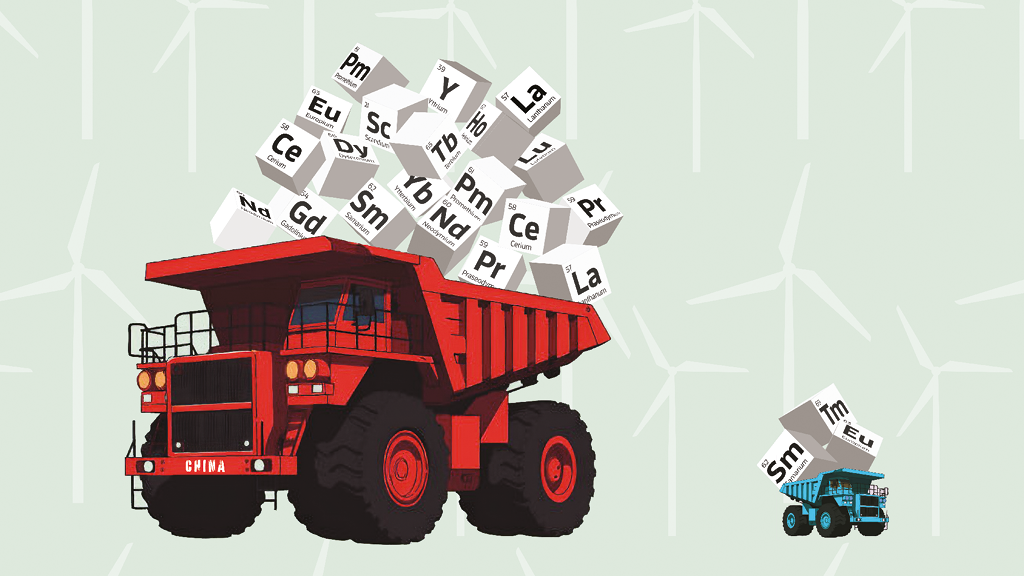
The shift to clean energy and advanced technologies is redrawing the map of global economic power. As nations and firms race to secure critical minerals, rare earths - small in trade value but high in strategic impact - have emerged as chokepoints for sectors from electric vehicles and wind power to defence and artificial intelligence (AI), due to China's dominance which has the potential to transform global supply chains.
Critical minerals are foundational to the green energy transition, AI-driven digitalisation and the global wave of rearmament. Yet, at first glance, rare earths seem economically marginal. In 2021, the total global export value of rare earths was only about $0.59bn - a fraction of the $1.5bn market for lithium, the $4.2bn market for nickel and the $91bn market for copper (IRENA, 2023). Compared with the $951bn global petroleum trade, rare earths look like a footnote rather than a strategic fulcrum.
The reality is more complex. Despite their name, rare-earth elements are not geologically scarce. They are found in many countries and could, in principle, be mined more widely, especially where environmental regulations are less stringent. China is currently the world's largest rare earth miner, but its exports account for only about one-third of global annual demand. This suggests that other nations could readily diversify supply.
The real source of vulnerability lies not in the volume or geology of rare earths, but in the structure of the value chain. Over three decades, Beijing has built dominance across nearly every stage of rare-earth production - with particularly tight control in the later, higher-value phases.
China accounts for roughly 60% of global mining output, 91% of global production and a striking 94% of permanent magnet manufacturing, especially of neodymium-iron-boron magnets (IEA, 2025a; Kim et al, 2025). These magnets are vital for electric vehicles, wind turbines, advanced electronics and defence applications.
China has leveraged its resources and capabilities in the early part of the value chain to attract ever more businesses and components of the value chain to relocate to China, due to the abundant resources, low-cost material and a concentration of capabilities. This has left Western firms exposed as capabilities have been lost.
Visiting Inner Mongolia in 1992, the late Chinese leader Deng Xiaoping said famously: "The Middle East has oil and China has rare earths". His prescience about the importance of this resource has been leveraged by China to build a capability on which the world is now reliant.
The power and threat of the 0.1% rule
In October 2025, Beijing introduced new rules requiring foreign companies to obtain Chinese government approval to export any product containing more than 0.1% rare earths by weight and to declare their intended use. Officially described as administrative management, the measure gives China a powerful tracing tool and, potentially, a lever for future export restrictions.
According to the OECD, the number of export restrictions on critical materials has increased more than fivefold between 2009 and 2023. In 2023 alone, over 500 new raw material products were added to the list of products with at least one restriction, with 94% of these net additions originating from just seven countries and China playing the largest role. Even if not framed as an outright ban, such controls allow Beijing to shape market access.
From grams to great power: illustrative leverage
In 2024, China mined approximately 270,000 metric tonnes of rare-earth oxides (REO) equivalent – the largest share of global production (US Geological Survey, 2025). Yet, the strategic leverage lies not in the raw tonnage alone, but in China's dominance over the value chain and the licencing rule.
If we assume that most high-tech products (electric vehicle motors, wind turbines, ICT devices, green technologies and defence equipment) contain about 1%-2% REO by weight, then the 270,000 tonnes of REO could be embedded in 13.5-27 million tonnes of downstream product.
Processed rare-earth materials are dozens of times more expensive than raw REO. Assuming an average value of roughly $10,000 per tonne for these final goods, the 0.1% rule gives China potential influence over an estimated $135bn-$270bn worth of high-tech products, far exceeding the value of the raw materials.
Technology, capabilities and dependency
China's control extends beyond materials. It also maintains tight restrictions on rare-earth processing and refining technologies, making it harder for other countries to build diversified supply chains. Over decades, China has accumulated deep technical expertise covering not just the processing of rare earths but also the equipment, tooling and tacit know-how essential for large-scale production.
For those in the West seeking to export Chinese-made equipment for processing rare earths, data are collected on the intended use of the equipment and who it will supply, further strengthening China's understanding of the use and applications of its products, and understanding of the supply chain.
Having ceded much of their rare-earth magnet manufacturing capacity, Western economies now face a steep relearning curve
Western economies, having ceded much of their rare-earth magnet manufacturing capacity, now face a steep relearning curve. Rebuilding technological capabilities will take time and significant investment, all while competing with China's entrenched cost and scale advantages. This highlights a critical dimension of resilience: supply security is not just about material access, but also about technological capability and innovation capacity.
Empirical evidence reflects this strategic exposure. Risks linked to critical minerals - including rare earths - have increasingly been flagged by listed companies worldwide. This is shown in an analysis of how businesses are responding to uncertainty surrounding critical minerals, carried out by combining firm-level data from nearly 14,000 publicly listed companies across more than 90 countries with textual analysis of transcripts from around 280,000 earnings conference calls - the calls in which company managers provide an evaluation of the firm's quarterly performance and then answer questions (Nguyen-Tien, 2025).
The analysis suggests that exposure to some risks has been associated with lower revenue growth, particularly in clean tech sectors. Classic profit-uncertainty models suggest that price volatility reduces expected returns, prompting firms to scale back output and investment - and underlining why building resilience through innovation, diversification and strategic stockpiling is increasingly essential.
Resources wars, trade wars and the G2 truce
The wave of US-China trade tensions during Trump's first presidency was bilateral, driven by reciprocal tariffs targeting specific sectors. The current wave is far broader, reflecting global fragmentation of trade and technology. Where US tariffs operate on the demand side, China's rare-earth strategy works on the supply side, controlling key upstream inputs. This asymmetry gives Beijing leverage over global technology supply chains, amplifying geopolitical risks. Even limited disruptions could cascade through clean energy, electronics and defence sectors.
In response, the second Trump administration has pursued a series of initiatives to secure alternative rare earth supplies - most notably, a $8.5bn deal with Australia promising industrial cooperation and joint investment to build rare-earth processing capacity outside China. In addition, Washington has reached agreements with Cambodia, Japan, Malaysia, Thailand and Vietnam aimed at diversifying supply chains and strengthening industrial collaboration in the region.
Yet, establishing a complex rare-earth supply chain takes years - not to mention raising questions about the economic viability of such projects without supportive industrial policies. In the meantime, buying time matters. In October 2025, at a "G2" meeting, Trump and Xi reached a one-year rare-earth trade truce, which postpones China's export controls on the materials, alongside other measures, including selective tariff reductions.
While the truce may be extendable, it remains a short-term tactic amid deepening geopolitical competition. For US allies and partners beyond the G2, securing reliable rare-earth supplies will remain critical for the manufacture and deployment of next-generation technologies.
Beyond rare earths
Rare earths are not the only critical minerals over which China holds structural advantages. There are similar patterns of dominance for lithium, cobalt, graphite, magnesium, tungsten, gallium and germanium, among others, reflecting a broader geopolitical strategy that leverages resource control for economic and strategic influence.
The resilience of emerging technologies will depend not only on innovation, but also on the ability to manage and mitigate resource dependencies
As global demand for critical minerals accelerates, the intersection between resource security, technological sovereignty and geopolitical rivalry is becoming a defining feature of the 21st century economy. The resilience of emerging technologies will depend not only on innovation, but also on the ability to manage and mitigate resource dependencies.
This is the new era of strategic interdependence: control over even a small fraction of a material can influence entire industries. Building resilience - through diversification, technological innovation and cooperative frameworks - will be central to navigating this evolving global landscape. Collaboration across governments, firms and research institutions will be essential to develop adaptive strategies, anticipate risks and sustain innovation in critical technologies.
An earlier version of this article first appeared on "LSE USA Politics and Policy.
Gavin Harper is a research fellow at the University of Birmingham's Centre for Strategic Elements and Critical Materials. Viet Nguyen-Tien is a research officer at CEP, contributing to the growth programme, the Programme on Innovation and Diffusion (POID) and the Productive and Inclusive Net Zero research project (PRINZ).
Further reading
IRENA (2023) 'Geopolitics of the energy transition: critical materials'.
IEA (2025) 'Renewables 2025'.
Kim, T-Y., Dhir, S., Dasgupta, A. and Scanziani, A. (2025) 'With new export controls on critical minerals, supply concentration risks become reality' IEA.
Nguyen-Tien, V. (2025) 'Cleaner energy, higher risk? Firm-level exposure to critical minerals', CEP Discussion Paper No. 2133.
OECD (2025) 'OECD Inventory of export restrictions on industrial raw materials 2025'.
US Geological Survey (2025) 'Mineral commodity summaries'.
20 February 2026 Paper Number CEPCP727
Download PDF - Cleaner energy, higher risk?
This CentrePiece article is published under the centre's Green Transition programme.
This publication comes under the following theme: Clean growth