
Research: Productivity
Revving up wages: How rising productivity has benefited car industry workers
Tim Obermeier and Andreas Teichgraeber
Fast productivity growth in the UK car industry led to staff in the sector earning about 37% more than the average manufacturing employee by the 2010s. But Andreas Teichgraeber and Tim Obermeier show that while wages went up, the share of the productivity gains going to workers declined.

Real wages of UK workers have stagnated since the global financial crisis of 2007-09. At the same time, labour productivity, the value of goods produced per worker, has seen minimal growth.
Many politicians, policymakers and economists attribute the stagnation in wages to sluggish productivity growth. By examining the relationship between productivity and wage growth in the UK car industry, we find that increases in productivity can indeed benefit workers. This evidence from one industry offers valuable insights for efforts to address the UK's broader productivity and wage growth challenges.
Our study covers the period from 1980 to 2018. With 1.5 million passenger cars produced in 2018, the UK was the fourth largest car-producing country in Europe (just behind France with 1.8 million cars). Several multinational companies such as Jaguar Land Rover, Nissan and Toyota produce in the country.
Over time, employment in the industry has declined, but there has been a strong increase in productivity. Our findings suggest that while this has helped to boost wages, the extent to which workers have benefited has changed. Among important insights for policymakers, we find that productivity growth can play an important role in raising wages. This is even more relevant in view of the stagnation of wage growth in the UK over the last 20 years.
A productivity surge in the car industry
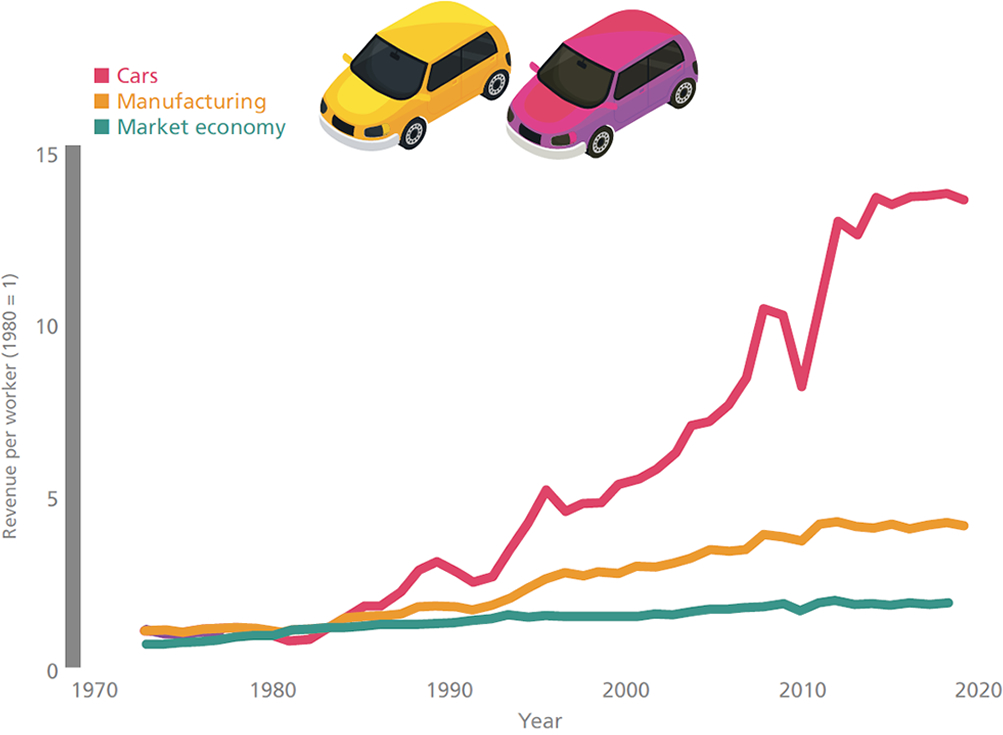
Over the past 40 years, there has been a remarkable growth in productivity in the UK car industry, with output per worker increasing twelvefold since 1980, far exceeding the fourfold increase seen across the broader manufacturing sector (see Figure 1). By 2018, the car industry's importance to the UK economy had grown, accounting for over 11% of the UK manufacturing output, up from just 5% in 1980.
Most of the wage growth for UK car workers can be linked to improved productivity
There are a few key drivers behind this. The industry became more deeply integrated into global supply chains, increasing outsourcing and reliance on parts from other countries. At the same time, carmakers invested heavily in automation, boosting the amount of machinery and technology used per worker. We find that this shift led to a significant improvement in total factor productivity, which is a measure of how efficiently resources like labour and capital are used. In fact, total factor productivity in the car industry grew at twice the rate of the rest of UK manufacturing.
Figure 1: Productivity growth in the UK car industry
Car workers fared better than others
The big question is whether these productivity gains have led to higher wages for car workers. Based on our findings, it seems that these workers have earned more compared with their counterparts in other manufacturing sectors. The "wage premium" – the difference between what car workers earn and what workers in other manufacturing sectors make – has grown significantly since the 1980s.
Back in the 1980s, car workers were earning about 18% more than the average manufacturing worker. We find that by the 2010s, that premium had nearly doubled to 37%. Even when we adjust for differences in education, experience and job roles, the premium increased from around 8% in the 1980s to 17% in the 2010s.
Both productivity and wages have increased substantially more in the car industry than in other sectors in the UK economy since 1980, but this does not mean, in itself, that there is a causal link between the two.
To understand how productivity growth has affected wages, we use what's called a rent-sharing model. Rent-sharing occurs when firms share a portion of their profits or productivity gains with workers in the form of higher wages. Our results suggest that around 63% of the increase in wages for car workers can be linked to the industry's productivity growth.
Car manufacturers have shared less of their gains with workers over time
But rent-sharing has fallen over time. In the 1980s, a larger share of productivity gains went to workers, but by the 2010s, this share had dropped. In fact, if rent-sharing had stayed at 1980s levels, wages for car workers today might be around 38% higher.
Lessons for policymakers
The experience of the UK car industry suggests that productivity growth can be an effective tool for raising wages. Supporting innovation, encouraging investment in new technologies and helping industries integrate into global value chains can help sectors to become more productive.
As the car industry demonstrates, when companies become more efficient, there's an opportunity for workers to benefit as well. The sector's strong productivity growth has led to significant wage gains for its workers, particularly in comparison with other manufacturing sectors.
This shows that increasing productivity can play a critical role in improving pay and living standards across the economy. Indeed, increasing productivity is a key part of the UK chancellor's "new era for economic growth", which she announced shortly after taking office.
But while productivity growth is key, it is also important to ensure that workers receive a fair share of the gains. Our findings suggest that car manufacturers have shared less of their gains with workers over time. Evidence from other research suggests that this is true in other sectors as well.
Implementing policies that bolster workers' bargaining power could help to ensure that productivity improvements translate into wage increases for workers.
Notably, productivity growth among UK car manufacturers (and other industries) has been on a downward trend since the Brexit referendum. If this pattern persists, the repercussions are likely to extend beyond job losses and reduced profits, affecting workers' wages too.
20 February 2025 Paper Number CEPCP699
Download PDF - Revving up wages: How rising productivity has benefited car industry workers
This CentrePiece article is published under the centre's Growth programme.