
Policy: Planning
Why don't we have nicer buildings?
Gabriel M. Ahlfeldt, Elisabetta Pietrostefani and Ailin Zhang
Distinctive urban architecture is a benefit, but few want to pay for it

One reason that cities often lack distinctive architecture is that markets do not fully reward good design. Economic research shows that buildings with distinctive architecture sell for around 15% more than comparable buildings. Architectural quality also spills over to neighbouring properties, which gain roughly 9% in value from being near to well-designed new buildings.
But developers capture only part of these gains while bearing the full cost of better design. As a result, cities may end up with too few distinctive buildings.
To understand what policies might address this problem, we built an economic model of how developers choose designs and how residents value them, grounding the analysis in the evidence on price premiums and design spillovers.
By using this to compare ways of encouraging more distinctive designs, we find that the policy offering the most benefits to society would be a subsidy of roughly 10% of construction costs for distinctive buildings.
What does economic research say about architecture?
A growing body of economic research examines how the design of buildings affects property markets, neighbourhoods and planning decisions. Perhaps unsurprisingly, buildings with distinctive designs sell for more (Vandell and Lane, 1989). But distinctive architecture also shapes the character of streets and neighbourhoods, making surrounding locations more attractive.
In London, for example, properties with a view of buildings rated as more beautiful command higher prices, indicating that people value architectural quality even when they do not occupy the building itself (Ahlfeldt and Holman, 2018). Similarly, study of the Netherlands finds that protecting distinctive buildings can also raise the value of neighbouring properties (Koster et al, 2016). Together, these findings suggest that architectural design generates local spillovers.
Other studies focus on how planning systems interact with architectural design to encourage distinctive buildings by offering incentives or regulatory flexibility. For example, in London, buildings designed by well-known architects are often allowed to be significantly taller than comparable developments (Cheshire and Dericks, 2020). Together, these findings suggest that architecture generates economic value - but they also raise questions about whether markets alone will deliver the level of design quality that people value.
Why markets produce too few distinctive buildings
The evidence that architecture affects property values raises an obvious question: if people value distinctive design, why do cities produce so many ordinary buildings? Economic research points to a simple explanation: the benefits to the developers - who are stumping up the money - are not enough to justify paying the extra cost.
When a developer invests in distinctive design, tenants and buyers inside the building may be willing to pay more. And while neighbours may also benefit from better surroundings, improved views and a more attractive street environment, it is unlikely that a developer would find these wider benefits enough of an incentive to invest in better design.
Economists describe this situation as a positive externality: the social value of architectural quality exceeds the private return to the developer who pays for it. This logic helps to explain why markets may produce too few distinctive buildings, even when residents value better architecture. Developers make rational decisions based on the incentives that they face, but those incentives do not reflect the full value that good design creates for the wider neighbourhood.
Policy ideas for better buildings
Our research synthesises dozens of empirical estimates of the value of architectural design and combines them with new evidence on how people value different styles of buildings. These empirical patterns are then used to build a quantitative model of neighbourhood development that captures how developers choose between ordinary and distinctive designs, and how residents respond to those choices. This model can then be used to explore how different policies would affect real-world cities.
If markets produce too few distinctive buildings, the next question is whether policy can help to correct this imbalance. When private incentives do not reflect the full social benefits of an activity, economists often recommend policies that encourage the activity until private and social returns are better aligned. One direct approach would be to subsidise distinctive architectural design. A subsidy would reward developers for the broader benefits that their buildings create for neighbours and the surrounding area.
Cities sometimes use other tools to encourage better design. For example, planning authorities may grant additional development rights to projects with distinctive architecture. In London, buildings designed by well-known architects are often allowed to be substantially taller than comparable developments. Such policies attempt to provide incentives for architectural quality indirectly by offering regulatory advantages.
Another approach is to designate areas where distinctive design is required or strongly encouraged. One example is the LSE campus, which lies within Westminster's Strand Conservation Area. The conservation area aims not only to preserve but also to enhance the character and appearance of the neighbourhood, with new development expected to respond positively to its architectural context. Recent additions to the LSE campus - including the Saw Swee Hock Student Centre, the Centre Building and the Marshall Building - illustrate how such a setting can accommodate striking contemporary architecture rather than simply reproducing historic styles.
While these policies can help to preserve architectural quality in certain locations, they can also have unintended consequences if applied too broadly. For example, if too many distinctive buildings are mandated in a particular district, developers may respond by opting for more ordinary designs in other parts of the city because demand for distinctive architecture has already been met. This could happen even where those other locations might be better suited to high-quality design.
Evaluating these different approaches requires understanding how developers respond to incentives and how architectural spillovers affect surrounding neighbourhoods. Quantitative models of urban development make it possible to compare these policies and assess which ones are most likely to improve the overall quality of the built environment.
Finding peak subsidies
The simulations from the quantitative model suggest a clear policy implication. Because developers capture only part of the benefits that are created by distinctive architecture, encouraging better design can increase overall social wellbeing.
The policy that performs best resembles a subsidy for distinctive architectural design. Specifically, the welfare-maximising subsidy is around 10% of construction costs for buildings with distinctive design (see Figure 1). When subsidies are small, encouraging better design improves welfare because the additional architectural spillovers outweigh the costs. But the benefits do not increase indefinitely.
Figure 1: Welfare effects of a destinctive design subsidy
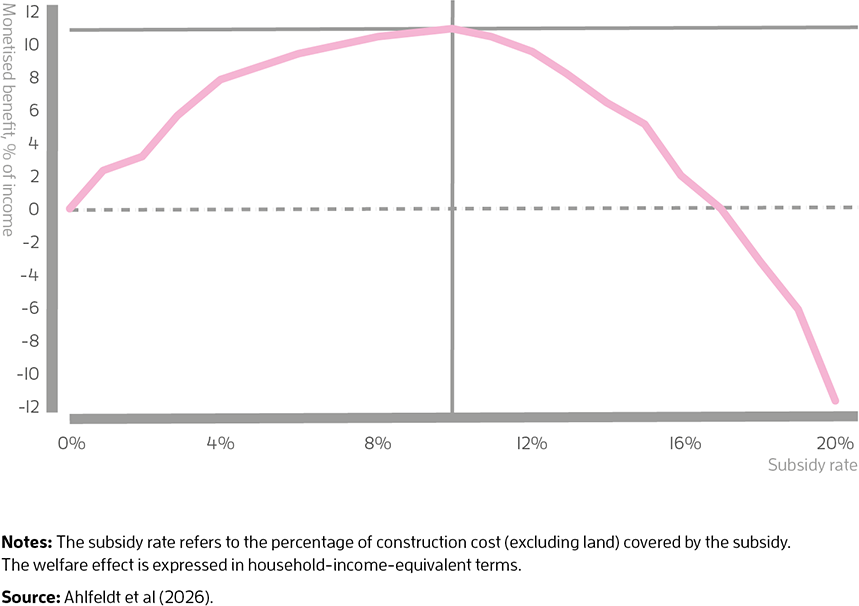
One reason is that tastes for architecture differ across residents. Distinctive buildings command a price premium partly because they are scarce and because some people strongly value living in them. As distinctive buildings become more common, the premium declines. More and more people end up living in buildings with distinctive design even though they do not particularly value it.
A second reason is that developers differ in their ability to deliver distinctive architecture efficiently. Some developers work closely with architects, and they can create distinctive designs at relatively low cost. Others find it more expensive to do so. As subsidies increase, more developers are encouraged to adopt distinctive designs, including those who are less efficient at delivering them.
Because the subsidy must be financed, these additional costs matter. At low subsidy levels, the value created by better architecture exceeds the public resources spent. But as subsidies grow larger, the additional buildings encouraged by the policy generate less value while the fiscal cost continues to rise. In the simulations, welfare reaches its maximum when subsidies are around 10% of construction costs and begins to fall if subsidies increase further.
The broader lesson is that architectural design, much like other urban amenities, creates benefits that extend beyond individual buildings. Because these benefits are shared, markets alone may produce too little distinctive architecture. But policies designed to encourage better design also need to be carefully calibrated so that the public resources spent do not exceed the value that they create.
Take the taste survey
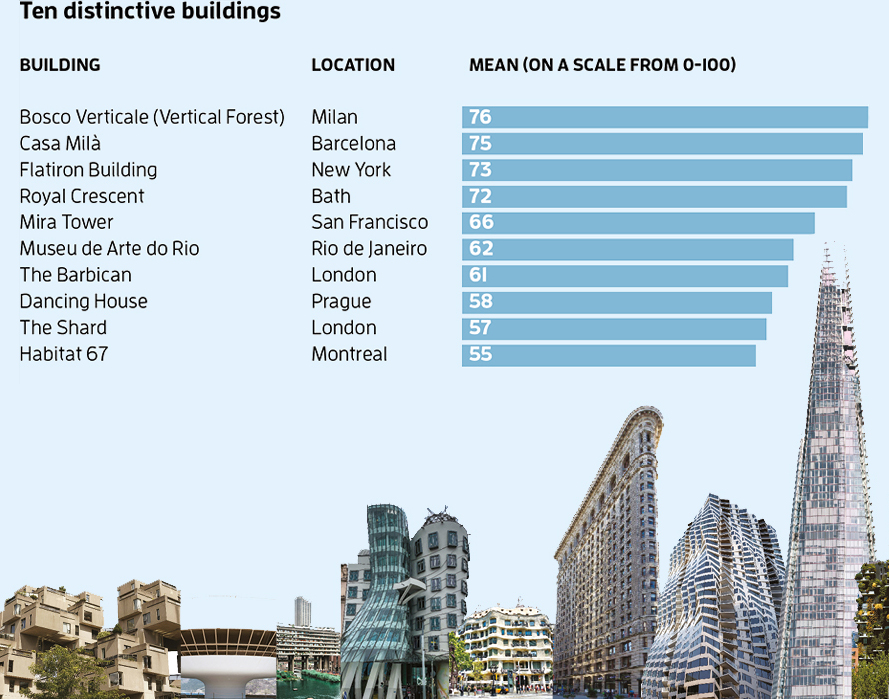
One person's distinctive design may be another's eyesore. So in order to assess how tastes in architecture vary, Gabriel Ahlfeldt, Ailin Zhang and Elisabetta Pietrostefani ran an internet survey based on 20 selected buildings: 10 iconic buildings (see below) and 10 nearby "ordinary" buildings. Each participant scored the design quality of 10 buildings - one from each iconicordinary pair - on a scale from 0 to 100. The 3,140 ratings from 314 respondents found that the mean building rating across all 20 buildings was 53, while ratings within each building had an average standard deviation (a measure of variation around the mean) of 22. The distinctive buildings had higher than average scores, but the survey revealed a wide variation in taste.
What do you think? Take the survey here: https://bit.ly/4hamJ9j.
Ahlfeldt, G.M., Pietrostefani, E. and Zhang, A. (2026) The economics of architecture. CEP Discussion Paper No. 2150. An earlier version appeared on the Economics Observatory.
Gabriel Ahlfeldt holds the Chair of Econometrics at Humboldt University in Berlin and is a research associate in CEP's urban programme. Elisabetta Pietrostefani is an assistant professor in geographic data science at Liverpool University. Ailin Zhang is a PhD student at LSE.
Further reading
Ahlfeldt, G. and Holman, N. (2018) 'Distinctively different: a new approach to valuing architectural amenities', Economic Journal, 128(608), pp. 1-33.
Cheshire, P. and Dericks, G. (2020) 'Trophy architects' and design as rent-seeking: quantifying deadweight losses in a tightly regulated office market', Economica, 87(348), pp. 1078-1104.
Koster, H., van Ommeren, J. and Rietveld, P. (2016) 'Historic amenities, income and sorting of households', Journal of Economic Geography, 16(1), pp. 203-236.
Vandell, K.D. and Lane, J.S. (1989) 'The economics of architecture and urban design: some preliminary findings', Real Estate Economics, 17(2), pp. 235-260.
20 October 2026 Paper Number CEPCP749
Download PDF - Why don't we have nicer buildings?
This CentrePiece article is published under the centre's Urban programme.