
Research: Gender
The childcare track
Sofie Cairo, Ria Ivandic, Anne Sophie Lassen and Valentina Tartari
One in three women and one in six men leave academia after becoming a parent

Women are under-represented at the top of most professions (Bertrand, 2018), including in academia (Auriol et al, 2022). We study whether and to what extent having children explains the persistent glass ceiling in academia.
The career ladder in academia is of particular interest as it is a "greedy" occupation (Goldin, 2014) due to its lack of substitutability among workers, long hours with increasing returns to productivity, and the importance of establishing and maintaining personal contacts.
More generally, academia is important to study as it has spillovers onto wider society as barriers to women in research risk a substantial loss in the overall quality and productivity of science (Hsieh et al, 2019), and less work on topics relevant for women (Antman et al, 2024; Einiö et al, 2019). What's more, a lack of role models might further discourage women's participation in fields dominated by men (Porter and Serra, 2020).
To study how children affect academic trajectories, we combine population level data on all individuals who started a PhD over a 25-year period in Denmark. This results in detailed information on educational and labour market outcomes, as well as personal and family characteristics of more than 13,000 individuals that we track from the start of their academic journey. We combine this with data on the research output of each individual, and a unique survey that elicits the aspirations and family constraints of academics and PhD students.
The impact of becoming a parent
We find that career trajectories for women and men track closely until the arrival of their first child. At that point, a striking divergence emerges with one in three women leaving academia when they become a parent, compared with one in six men (see Figure 1). This disparity translates into a long-run child penalty of 15% in academic employment. This gap is not driven by women moving to the broader research sector, pursuing academic careers abroad or exiting the labour market altogether.
Figure 1: Impact of children on university employment
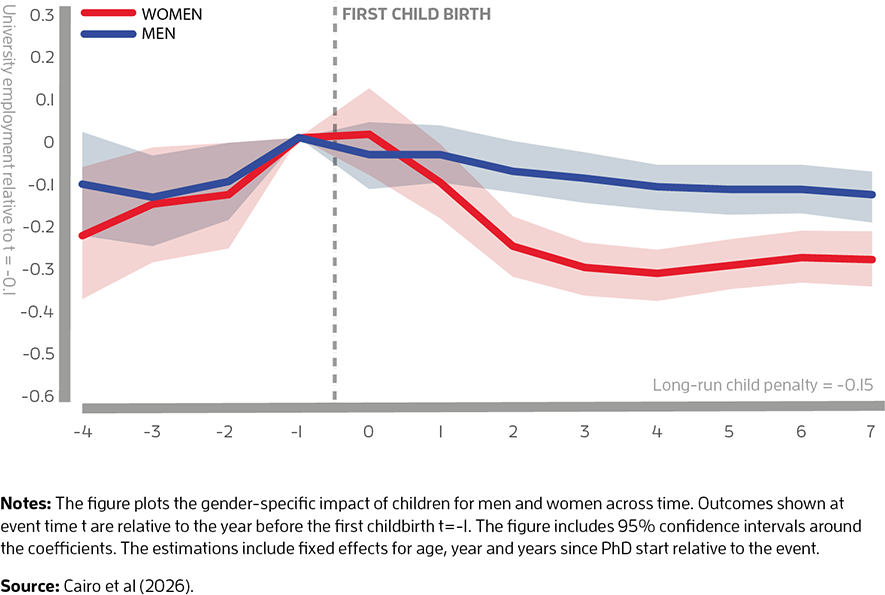
On average, these women still experience a substantive child penalty in earnings, while men's earnings are not affected. Women's likelihood of having a tenured position, defined as an associate or full professorship, drops after motherhood and remains 23% lower than men's eight years later. Fatherhood has no detectable effect on men's likelihood of tenure.
While research output drops and remains 31% lower for women, men's research output isn't affected by fatherhood. Nonetheless, we find that rather than the difference in the rate of output after becoming a mother, the most important determinant for under-representation of women in senior positions is their disproportionate exit from the profession following motherhood.
While most Danish academics believe that work and childcare should be shared equally between partners, mothers do five times more caring than fathers
Equal ambitions but different realities
What explains this divergence? A common explanation is that women may have lower career ambitions, but our findings suggest that the observed gaps are not driven by differences in ambition or preferences at the outset of academic careers.
Using novel survey evidence collected among PhD students, we find that men and women report strikingly similar aspirations for academic careers. Both groups express equal interest in research and teaching, and place comparable importance on key job attributes such as career advancement, intellectual challenge, independence and job security.
But after becoming parents, women in academia adjust their behaviour substantially more than men (Figure 2). Both men and women academics report on average working seven hours longer than the average working Dane, yet women academics with preschool-aged children work four hours less per week than men with children of the same age, corresponding to a 10% shorter work week.
Figure 2: Working hours and childcare split
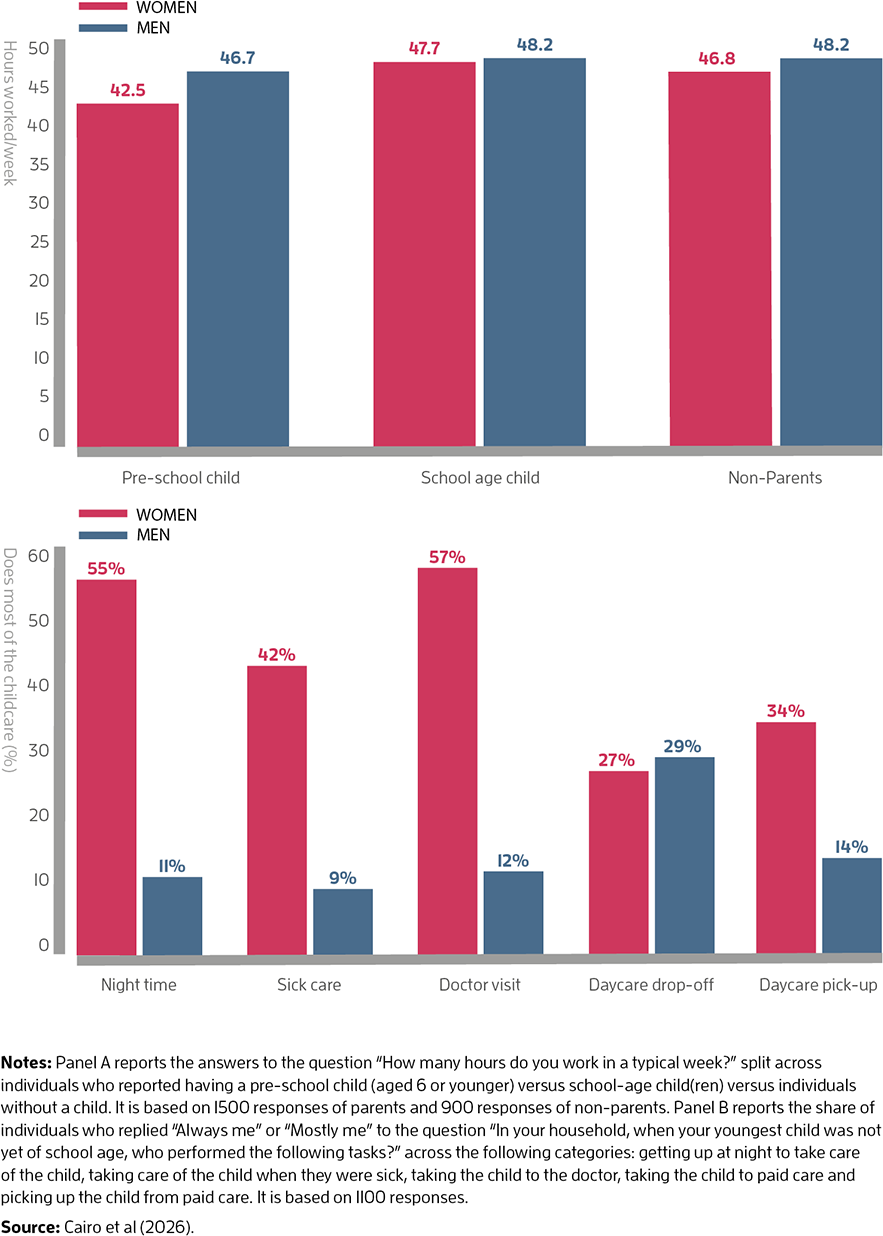
While the vast majority of both men and women academics believe that work and childcare should be shared equally among partners, they also report that mothers assume five times as many childcare responsibilities than fathers. The gender differences in childcare are particularly pronounced for care with unpredictable timing that constrains working ability, such as doctor's visits, sick days and night-time childcare.
We also find that mothers are less likely to move for their academic job than fathers or academics without children. This vastly reduces their employability options.
We show that child penalties are not reduced if the woman's partner has an academic background himself or takes up paternity leave. The availability of grandmaternal childcare also does not mitigate the penalties. This speaks to the fact that these margins of additional help cannot compensate for the overwhelming majority of constraints on hours and mental load that motherhood places on women.
A strongly gendered pattern of domestic division of labour plus differences in who takes up and moves for 'greedy' jobs leads to the under-representation of women in academia
Flexibility can only stretch so far
Finally, we document how different work environments affect the size of penalties.
We find that different scientific fields, despite varying workplace flexibilities, yield the same child penalties. This implies that flexibility doesn't compensate for the demand on hours. Consistent with previous findings on women role models (Porter and Serra, 2020; Kjelsrud and Parsa, 2024), we find that women trained in departments without senior women and in highly productive, competitive departments face larger child penalties. This speaks to a barrier that contributes to the leaky pipeline of women - a lack of role models and a competitive work environment that interacts negatively with childcare responsibilities.
In sum, we find that around 70% of the observed gender gap in academic employment and around 40% of the gender gap in tenure can be attributed to child penalties (Kleven et al, 2024).
Even in one of the most progressive societies with generous parental leave policies, universal childcare coverage and among the highly-educated people saying that they believe childcare should be shared, a strongly gendered pattern of domestic division of labour plus differences in who takes up and moves for "greedy" jobs leads to the under-representation of women in science and academia.
This article summarises Cairo, S., Ivandić, R., Lassen, A.S. and Tartari, V. (2026) Parenthood and the career ladder: evidence from academia. CEP Discussion Paper No. 2160. An earlier version appeared on LSE Impact.
Sofie Cairo is an assistant professor at the department for strategy and innovation at Copenhagen Business School. Ria Ivandić is an assistant professor at the University of Zagreb and a research associate in CEP's wellbeing programme. Anne Sophie Lassen is a post-doctoral researcher at the Berlin Social Science Center (WZB), affiliated with the Berlin School of Economics and Copenhagen Business School. Valentina Tartari is the Jacob and Marcus Wallenberg Professor of Innovative and Sustainable Business Development at the Stockholm School of Economics and affiliated with the department of strategy and innovation at Copenhagen Business School.
Further reading
Antman, F.M., Doran, K.B., Qian, X. and Weinberg, B.A. (2024) 'Demographic diversity and economic research: fields of specialization and research on race, ethnicity, and inequality', AEA Papers and Proceedings, 114, pp. 528-534.
Auriol, E., Friebel, G., Weinberger, A. and Wilhelm, S. (2022) 'Underrepresentation of women in the economics profession more pronounced in the United States compared to heterogeneous Europe', Proceedings of the National Academy of Sciences, 119 (16) e2118853119.
Bertrand, M. (2018) 'Coase Lecture - The glass ceiling', Economica, 85: 205-231.
Einiö, E., Feng, J. and Jaravel, X. (2019) Social push and the direction of innovation, Available at SSRN.
Goldin, C. (2014) A grand gender convergence: its last chapter, American Economic Review, 104(4), pp. 1091-1119.
Hsieh, C.-T., Hurst, E., Jones, C.I. and Klenow, P.J. (2019) 'The allocation of talent and US economic growth', Econometrica, 87(5), pp. 1439-1474.
Kjelsrud, A. and Parsa, S. (2024) Mentorship and the gender gap in academia. Available at SSRN.
Kleven, H., Landais, C. and Leite-Mariante, G. (2025) 'The child penalty atlas', The Review of Economic Studies, 92(5), pp. 3174-3207.
Porter, C. and Serra, D. (2020) 'Gender differences in the choice of major: the importance of female role models', American Economic Journal: Applied Economics, 12(3), pp. 226-254.
20 October 2026 Paper Number CEPCP747
Download PDF - The childcare track
This CentrePiece article is published under the centre's Labour programme.
This publication comes under the following theme: Gender in the labour market