
On the cover: AI
AI or remote working: which broke the career ladder?
Peter John Lambert and Yannick Schindler
Disentangling the reasons for the sharp fall in entry-level hiring
Over the past three years, an explanation has emerged for why landing a first white-collar job has become so much harder - the arrival of generative artificial intelligence (AI). The argument is that fewer junior staff members are needed for tasks such as routine drafting, data processing and the initial stages of research - and so early-career hiring has begun to decline.
In our research, we suggest that another important driver of the decline in junior hiring is the increase in working from home (WFH) following the Covid-19 pandemic.
The decline in junior hiring itself is not in doubt, and a growing body of research concludes that generative AI is the cause, substituting directly for the routine analytical tasks firms once assigned to early-career workers. One influential study, drawing on payroll records, reports a 16% relative employment fall for the most AI-exposed workers aged 22-25 (Brynjolfsson et al, 2025). Another tracks individual firms and finds junior hiring slowing once companies adopt AI (Hosseini Maasoum and Lichtinger, 2025).
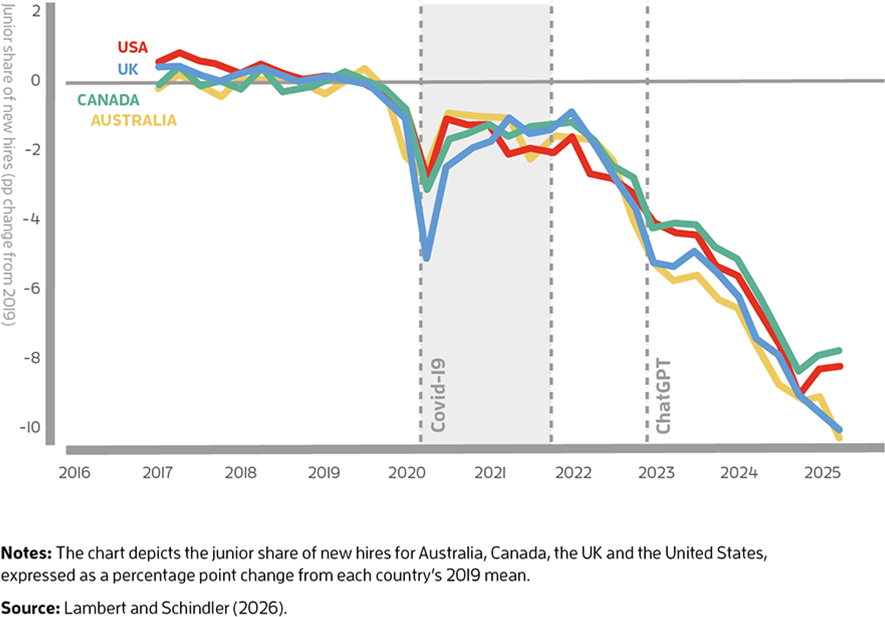
In our study, we use data from workers' CVs to revisit this question. First, we measure the share of all new hires going to junior workers. Our data, which span four countries, reveal that the share of junior hiring (relative to all hiring) fell by around 10 percentage points between 2017-25 (see Figure 1).
Figure 1: Junior share of hiring has declined sharply across four Anglophone economies, 2017-2025
The AI narrative resonates because, at a task level, the functions of the technology mirror the duties that once fell to a firm's newest recruits: such as writing routine press releases or answering customer service calls. These are exactly the tasks that a language model now does in seconds.
Two shocks that arrived at the same time
We revisit this question because another large post-pandemic shift has hit the very same occupations that are most exposed to AI: the rapid and persistent rise of WFH (Barrero et al, 2021). Our hypothesis is that part of the effect being attributed to AI may be a case of what economists call "omitted variable bias", allowing the effects of WFH to masquerade as a shift brought on by AI.
Young people face a double whammy: remote working has made them less desirable to hire and AI has made them less necessary
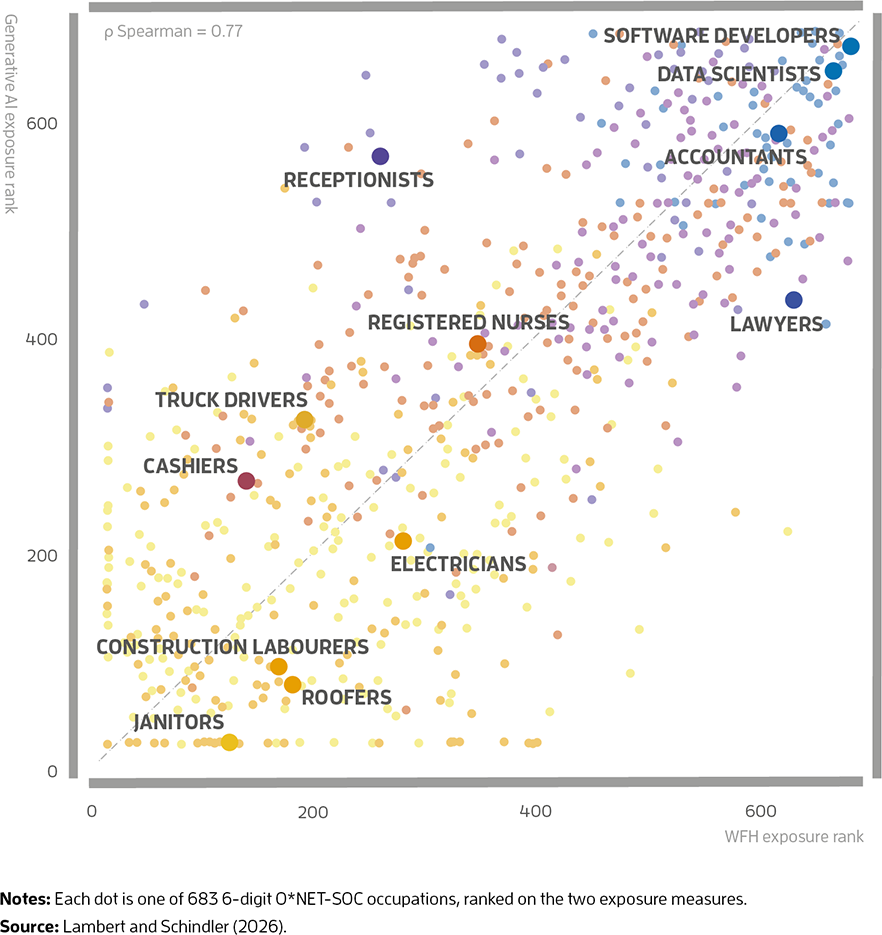
The jobs most exposed to generative AI are also those most likely to have gone remote: white-collar, desk-based and routine-cognitive work. Software developers, accountants and management consultants sit at the top of both rankings, and the standard measure of AI exposure (Eloundou et al, 2024) and the standard measure of working-from-home exposure as shown at wfhmap.com are correlated at 0.77 (see Figure 2).
Figure 2: Working from home and generative AI exposure are highly correlated across occupations
To pull the two apart, we analyse data on 243 million records on new hires and 407 million online job postings across Australia, Canada, the UK and the United States covering 2017 to 2025.
The evidence that we find most convincing comes from firms' actual adoption of remote work, based on explicit mentions of offering remote work for a particular role in the firm's job postings. Companies that offered remote or hybrid roles in 2021 or 2022 went on to cut the junior share of their hiring relative to firms that did not offer remote work but were otherwise similar. This result holds even when we match firms on their exposure to AI and WFH exposure, based on their occupation mix.
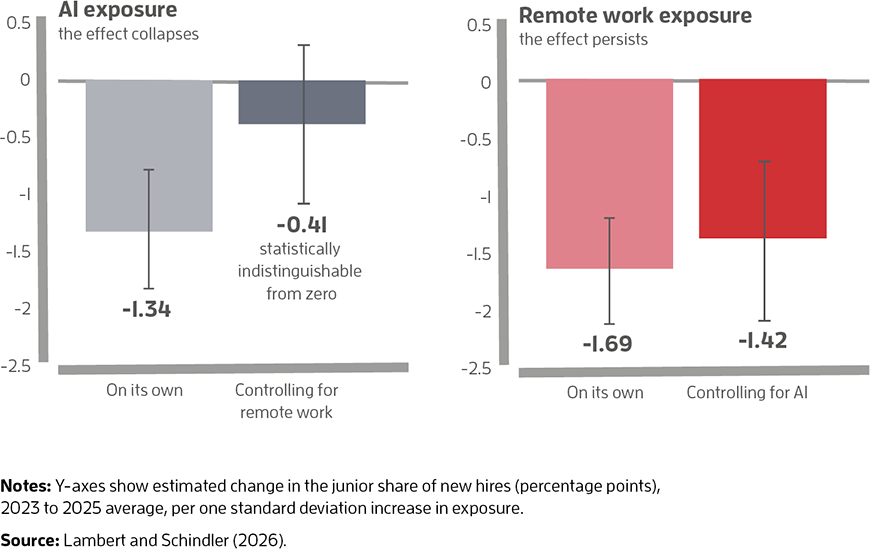
When considering only one exposure measure at a time (either an occupation's generative AI exposure or its WFH exposure), a two standard deviation increase in either measure predicts roughly a 5 percentage point fall in the junior share of new hires and a 3 percentage point drop in the share of adverts for inexperienced workers. But when accounting for both exposure measures in the analysis, the AI effect shrinks while the remote work effect remains significant (see Figure 3).
Figure 3: The AI effect attenuates once remote work is taken into account
To put the WFH effect into context, compare construction carpenters, whose work is hard to do from home, with financial analysts, where working a few days from home has become commonplace. By 2025, relative to carpenters, roughly one in 20 new financial analyst hires switched from junior to senior roles, and one in 33 analyst job adverts has raised its experience requirement above three years.
Why remote work can be problematic for juniors
Junior employees need supervision, feedback and on-the-job learning to become productive (Aksoy et al, 2025). This process is helped by working alongside senior colleagues: a quick question across a desk, a manager overhearing a mistake or the informal apprenticeship of watching experienced employees. A study of software engineers at a Fortune 500 firm finds that sitting near to colleagues raises the feedback received by 18%, with gains concentrated among the youngest (Emanuel et al, 2023).
Remote work makes that harder and more costly (Yang et al, 2021). Mentoring becomes a scheduled video call rather than a passing conversation, and the "out of sight, out of mind" effect falls hardest on those who most need to be seen - junior staff members. When the speed at which junior workers become experienced workers slows down, firms place less value on hiring workers who still need to be trained. As a result, firms pull back from hiring inexperienced workers.
We are careful not to rule out the role of generative AI, but rather highlight the challenge of separating the two effects. Other work using payroll data emphasises that generative AI effects survive controlling for WFH intensity (Brynjolfsson et al, 2025).
Part of the decline in junior hiring is due to remote work – but workplace reorganisation can address this
What we may be looking at is a double whammy: two shocks that have made junior staff both less desirable to hire, due to supervision and monitoring frictions, and less necessary, due to AI tools augmenting senior staff and automating junior roles.
David Deming of Harvard University calls this the "containerization" of work - an apt description of how the pandemic broke white- collar jobs into self-contained, well-specified chunks that can be handed over remotely - and just as easily to machines. Market signals cut both ways too: IBM plans to triple its US entry-level hiring around AI-redesigned roles and Dropbox is expanding graduate intake by a quarter.
Addressing the costs of remote working while retaining the benefits
To the extent that the slowdown in junior hiring is attributable to WFH, the implication is encouraging: organisational frictions are a more tractable challenge than technological displacement. Management practices can be changed, mentorship practices updated and training to prepare today's juniors for future leadership roles can be prioritised. As a last resort, an extra day per month in the office can also help (Aksoy et al, 2026) - something that's already happening as firms in finance, technology and media bring staff back to the office.
We stress that our findings are not an argument in favour of a blanket return to five days per week in the office. Remote work has wide-ranging benefits (Bloom et al, 2024) and full reversion to in-person work is both unlikely and undesirable. The fix is more likely to be better use of time spent onsite, ensuring that in-person days are loaded with opportunities for feedback, mentoring and learning.
Two significant disruptions arrived in workplaces at almost the same time, and they need to be studied together. Our findings complement the existing AI evidence rather than overturning it: at least a part of the decline in junior hiring appears to be due to the adoption of remote work.
Fortunately, that part can be, and should be, mended by workplace reorganisation that both keeps the many benefits of remote work while also ensuring that onsite days deliver the type of training and tacit knowledge transfer required to create the next generation of senior workers.
This article is based on Lambert, P.J. and Schindler, Y. (2026) The Broken Ladder: AI, Remote Work, and Early-Career Hiring, CEP Discussion Paper No. 2193. An earlier version first appeared on LSE Business Review.
Peter John Lambert, an economist with positions at LSE and the University of Warwick, is a research associate in CEP's growth programme. Yannick Schindler is a senior research economist at the Ellison Institute of Technology and a senior research fellow in the department of economics, University of Oxford.
Further reading
Aksoy, C.G., Bloom, N., Davis, S.J., Marino, V. and Özgüzel, C. (2025) Remote work, employee mix, and performance. NBER Working Paper No. 33851.
Aksoy, C.G., Bloom, N., Davis, S.J., Marino, V. and Özgüzel, C. (2026) The value of one office day a month. CEPR Discussion Paper 21597.
Barrero, J.M., Bloom, N. and Davis, S.J. (2021) Why working from home will stick. NBER Working Paper No. 28731.
Bloom, N., Han, R. and Liang, J. (2024) 'Hybrid working from home improves retention without damaging performance', Nature, 630, 920-925.
Brynjolfsson, E., Chandar, B. and Chen, R. (2025) Canaries in the coal mine? Six facts about the recent employment effects of artificial intelligence. Stanford Digital Economy Lab Working Paper.
Eloundou, T., Manning, S., Mishkin, P. and Rock, D. (2024) 'GPTs are GPTs: an early look at the labor market impact potential of large language models', Science, 384 (6702), pp. 1306-1308.
Emanuel, N., Harrington, E. and Pallais, A. (2023) The power of proximity to coworkers. NBER Working Paper No. 31880.
Hosseini Maasoum, S.M. and Lichtinger, G. (2025) Generative AI as seniority-biased technological change: evidence from US résumé and job posting data. SSRN Scholarly Paper 542555
Lambert, P.J. and Schindler, Y. (2026) The Broken Ladder: AI, remote work, and early- career hiring. CEP Discussion Paper No. 2193.
Yang, L., Holtz, D., Jaffe, S., Suri, S., Sinha, S., Weston, J., Joyce, C., Shah, N., Sherman, K., Hecht, B. and Teevan, J. (2022) 'The effects of remote work on collaboration among information workers', Nature Human Behaviour, 6(1), pp. 43-54
20 October 2026 Paper Number CEPCP743
Download PDF - AI or remote working: which broke the career ladder?
This CentrePiece article is published under the centre's Labour programme.
This publication comes under the following theme: Labour market dynamics