
Research: Community
The lasting impact of 9/11 on Muslim integration in America
Understanding the long-term social impact of historical events provides insights into current global debates on immigration, integration and Islamophobia. In a study of the aftermath of the 9/11 attacks, Shadi Farahzadi finds that the intermarriage rate of Muslims fell by eight percentage points relative to other minority groups.
The terrorist attacks of 11 September 2001 profoundly altered American society, shaping attitudes towards Muslim communities in ways that extend well beyond national security policies and civil liberties. One of the overlooked yet deeply significant consequences of this shift has been the effect on intermarriage between Muslims and non-Muslims.
This is a powerful indicator of the degree of progress or regress on social integration, offering unique insights into how communities connect and blend across ethnic, racial and religious lines. Examining how 9/11 influenced marriage choices provides a deeper understanding of American society, showing that a single event can reshape not just headlines or policies, but also the deeply personal decisions people make about love and family.
How intermarriage reflects social integration
Intermarriage across communities or groups is a key indicator of integration, reflecting how different communities connect and form lasting relationships. It goes beyond social interactions, shaping the fabric of future generations. When individuals from diverse backgrounds marry, their children grow up in multicultural environments, gaining exposure to different cultures, languages and perspectives. This fosters greater cross-community understanding and broader social networks.
Conversely, a decline in intermarriage can reinforce the societal divisions that persist across generations. Unlike employment opportunities, which are shaped by policies and regulations, marriage decisions are deeply personal and often reflect societal attitudes. A rise in intermarriage suggests a society that is becoming more open and inclusive, while a decline can indicate growing social and cultural divides.
Do Muslims marry non-Muslims?
Before 9/11, American (US-born) Muslims intermarried at relatively high rates, with about 65% marrying outside their faith, most of them to white Americans (see Figure 1). This notably high rate reflects both the growing integration of American Muslims during this period and the relatively small size of the Muslim community, which meant many Muslims met and formed relationships with people outside their faith. This pattern suggested a growing acceptance and blending of communities before 9/11 altered the landscape.
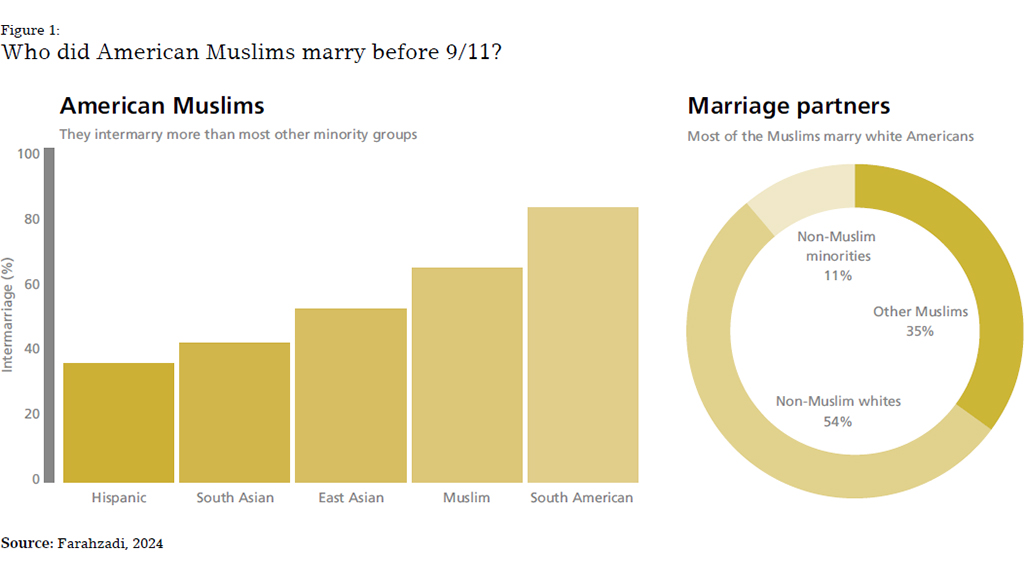
Even though many Muslims marry outside their faith, the rate is lower than we would expect if people were choosing partners completely at random. The reluctance to intermarry seems to come more from non-Muslims than from Muslims themselves. Non-Muslims who did marry Muslims were more likely to choose highly-educated partners compared with those who married within their own group.
This suggests that for Muslims, breaking social barriers in marriage often required higher socio-economic status, as non-Muslims were more open to interfaith relationships when their partner had higher socio-economic status.
The aftermath of 9/11 led to a dramatic shift in marriage patterns among American Muslims. Rising anti-Muslim sentiment, fuelled by increased surveillance (Khan and Ramachandran, 2021), media narratives (Alsultany, 2012) and political rhetoric (Archetti, 2010) created an environment in which interfaith relationships became more difficult to form and sustain.
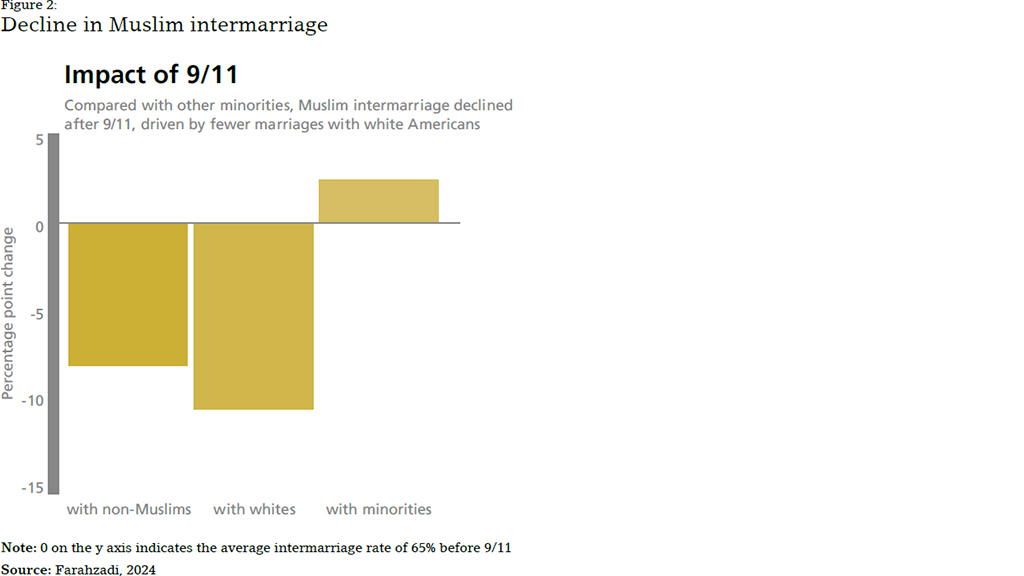
My research uses data from the American Community Survey for the period from 2008 to 2019, focusing on couples who got married between 1990 and 2015. It shows that after 9/11, the intermarriage rate among Muslims fell by eight percentage points relative to other minority groups. There was an even sharper 11 percentage point decline in marriages between Muslims and white Americans (see Figure 2). Hence, fewer Muslims married white Americans, with a corresponding increase in marriages to individuals from other ethnic minority groups.
The shift was particularly pronounced among highly-educated Muslims, who previously had the highest intermarriage rates. Instead of an increase in singlehood or divorce, Muslims adapted by marrying within their own religious and cultural communities at higher rates. In particular, American Muslim men increasingly married immigrant Muslim women, reinforcing cultural and religious ties within their communities.
Why changing marriage patterns matter
Marriage has profound implications for social cohesion. Interfaith marriages had been an important avenue for cross-community social bonds in the United States, breaking down stereotypes and fostering mutual understanding. As these marriages declined, opportunities for social cohesion weakened, reinforcing cultural divisions. The post-9/11 shift in social attitudes created a lasting “integration penalty” for American Muslims, restricting one of the most fundamental avenues for social mixing.
Understanding the dynamics of Muslim marriages provides insight into the broader challenges of integration and social acceptance in the United States. While overt discrimination can be addressed through legal protections, shifts in social attitudes – especially those influenced by major geopolitical events – require deeper studies.
Promoting positive intergroup relations, reducing stereotypes and fostering environments that encourage social mixing can help to counteract the long-term effects of shocking events like 9/11. Integration is not just about economics or policy; it is deeply rooted in the personal and social fabric of society. The choices people make in their personal lives, including whom they marry, can tell us a great deal about the barriers that still exist to a truly inclusive society.
Non-muslims who did marry Muslims were likely to chose highly-educated partners compared with those who married within their own group
20 June 2025 Paper Number CEPCP707
Download PDF - The lasting impact of 9/11 on Muslim integration in America
This CentrePiece article is published under the centre's Labour programme.