
Policy: Economic geography
Why people like living in cities: a new measure of the quality of life
Gabriel M. Ahlfeldt, Fabian Bald, Duncan Roth and Tobias Seidel
People like to live in certain places, even when higher wages are on offer elsewhere. Gabriel Ahlfeldt, Fabian Bald, Duncan Roth and Tobias Seidel show that once people?s preferences are considered, big cities offer a higher quality of life than previously thought.

Over half the world's population lives in cities. In developed countries, the share is significantly higher, while in developing countries, it is rising rapidly. Productivity advantages and correspondingly higher wages have been identified as driving this urbanisation since at least Alfred Marshall's seminal book, Principles of Economics, published in 1890.
There is abundant evidence confirming that productivity in cities is higher, making them attractive places to work. Cities may also be appealing places to live due to their many urban amenities, including ethnically diverse restaurants, music venues and art galleries. In contrast, rural areas may be attractive due to their natural amenities such as forests and lakes.
Economists refer to the joint effect of all such amenities on the perceived attractiveness of a location as quality of life. While there is a rich body of economic research on measuring quality of life, we know very little about whether it tends to be higher in cities than in rural areas. We argue that the lack of evidence for higher quality of life in cities may be due to measurement error.
Measuring people's choices
Empirically, it is challenging to measure quality of life, as many contributing amenities - such as the aesthetic quality of the built environment or the buzz of cutting-edge neighbourhoods – are unobservable or difficult to quantify. Therefore, economists infer this unobserved quality of life from factors that can be observed, namely wages and living costs.
Basic economic analysis (the canonical model) assumes that all goods (except housing) can be easily traded and all workers have the same tastes and can move freely. Under these assumptions, workers will move to different places - inducing changes in wages and house prices – until eventually any difference in quality of life will be balanced out by differences in wages and housing costs.
The main limitation of the canonical model is that it fails to take account of different spatial frictions - the constraints on movements of goods or people. For example, if there are trade frictions such as transport costs or tariffs, then non-housing prices will differ between locations for reasons unrelated to quality of life.
Alternatively, if there are mobility frictions, such as people’s personal preferences for specific locations or local ties to family or friends, small differences in wages generally will not be enough to persuade workers to move away.
We argue that by taking account of these spatial frictions, quantitative spatial models reduce measurement error. Our theoretical analysis indeed confirms that the difference in quality of life between locations tends to be underestimated in the canonical model. The extent of measurement error tends to be most pronounced in big cities.
Our analysis also provides insights into the relative importance of different spatial frictions for the measurement error. It turns out that mobility frictions are a more important source of measurement error than trade frictions. We find these results are highly robust, making it a general finding that is likely to hold in many countries around the world.
A quality of life ranking for Germany
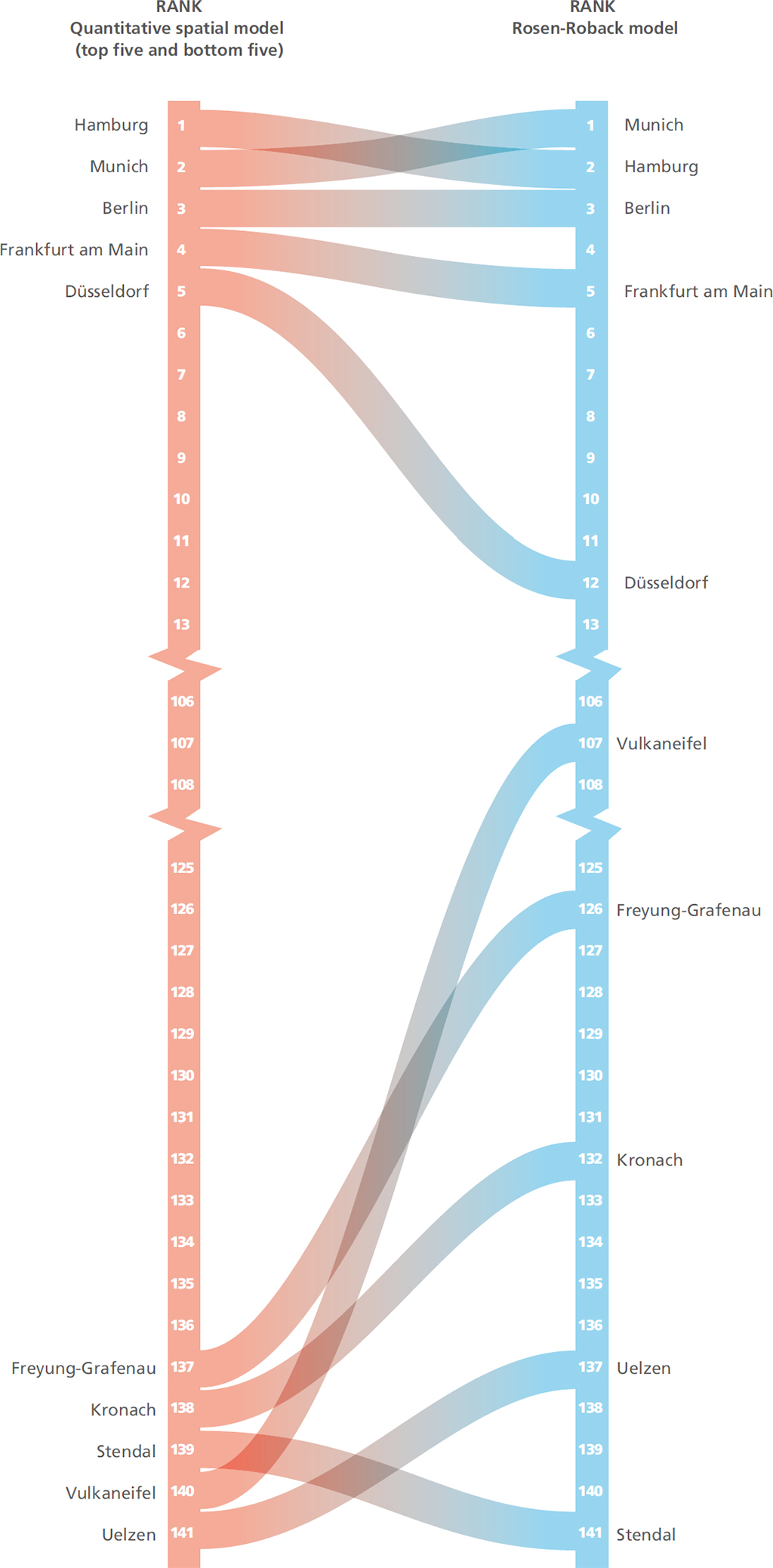
To produce the first theory-based quality of life ranking accounting for spatial frictions, we apply the model to data from Germany (Immoscout24, the Federal Employment Agency and the Federal Statistical Office). This application illustrates how our approach leads to greater variation in quality of life across regions and significant changes in rankings compared with measurement in the standard framework.
For example, comparing our approach with the canonical model for the year 2015, Hamburg is ahead of Munich as the city with the highest quality of life. Frankfurt climbs one place to fourth, Düsseldorf rises seven places from 12th to fifth and Chemnitz climbs 62 places to 39th, while fallers include Lörrach and Waldshut, which drop 50 places to 86th and 107th respectively. Only Berlin (3rd), Würzburg (25th) and Celle (122nd) remain unchanged.
Quality of life is a much more significant determinant of local economic development than previously thought
On average, the absolute rank change is 17. During recent years, Munich and Hamburg have been battling for first place in our ranking, switching positions from 2007 (#1 Munich) to 2011 (#1 Hamburg) and then again from 2015 (#1 Hamburg) to 2019 (#1 Munich). At the same time, Berlin has been catching up. It went from #4 in 2011 to #3 in 2015, and is getting closer and closer to Munich and Hamburg. We provide an interactive webtool, where users can explore quality of life rankings over time for any pair of German cities (see box).
Our quality of life measure also reveals that people like living in bigger cities. On average, doubling the population of a region is associated with a 20% increase in quality of life. For comparison, the same increase in the size of the region is associated with no more than a 5% increase in wages.
The left side of Figure 1 shows how our new quality of life measure reveals the highest quality of life in large city-regions such as Berlin, Hamburg and Munich. The right panel illustrates how our new measure estimates quality of life outside large city-regions, compared with the standard measure.
Figure 1:
Comparison of quality of life measures in Germany, 2015
Making cities attractive
Our findings suggest that quality of life is a much more significant determinant of local economic development than previously thought, showing that people's decisions on where to live are affected by more than just wages and housing costs.
This has profound implications for policymakers. Efforts to make struggling regions more productive are important, but equally critical is ensuring a high quality of life in cities to attract talent. Strategies could include investing in cultural and recreational amenities, reducing pollution and crime, or improving the built environment.
Using our toolkit
As a tangible contribution to the applied literature, we provide an accessible GitHub toolkit with parsimonious data requirements that solves for our new quality of life measure. Since our fully theory-consistent measure of quality of life is somewhat data-intensive, we also provide a crude-data version based on population statistics that still significantly reduces measurement error relative to the canonical measure. This tool should help policymakers identify areas with objectively low quality of life, allowing for a better understanding of the factors that are beneficial or detrimental to quality of life and, ultimately, economic prosperity.
Visit at: github.com/Ahlfeldt/ABRSQOL-toolkit
20 June 2025 Paper Number CEPCP704
Download PDF - Why people like living in cities: a new measure of the quality of life
This CentrePiece article is published under the centre's Urban programme.
This publication comes under the following theme: What determines urban growth and urban decline and what should be the role of policy?