
Special report: Daniel Kahneman
Remembering Daniel Kahneman
Following an LSE event discussing the legacy of Daniel Kahneman (5 March 1934 to 27 March 2024), Barbara Tversky remembers him and his work.
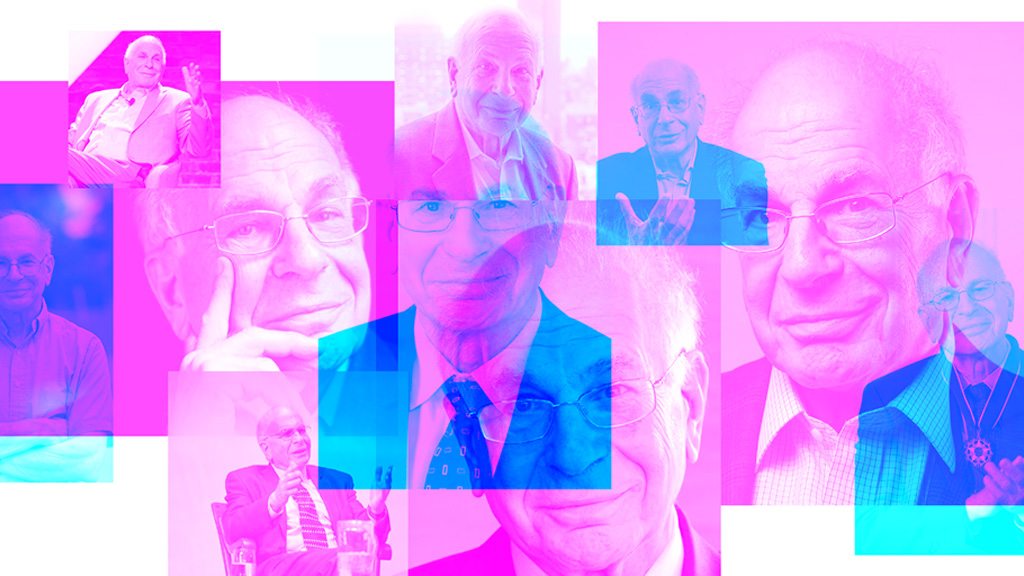
There were many Dannys. Each of us who knew him, knew different ones. I, myself, knew many. The first Danny I met was at the University of Michigan in 1965. He was a post-doc, I was a graduate student, soon to marry another Israeli, Amos Tversky. They knew of each other but hadn’t met. Israelis abroad gravitate to one another. That Danny was wiry and wired. Fast, eager to say, eager to do, eager to please, excited and excitable. Changeable, minute by minute. Pro, con, in the middle. One idea, then another. And another. Beginning a new sentence before he’d finished the previous. Upbeat, then sour. It was hard to get a fix on him, hard for him too, he hadn’t settled on who he was.
One Danny was certain. He was a psychologist, by inclination and by upbringing. His mother was a gossip, dissecting why people were the way they were, why they did what they did and what they didn’t do. It was never simple and rarely about money. It was about character encountering a situation.
Psychologists look at motives differently from econo-mists.
Danny entered psychology as an undergrad at Hebrew University at just the right time. The field was breaking the shackles of behaviourism. You could open the black box and peer into the mind. You saw the mind as an information processor. You could analyse your own intuitions, and you could test them in clever experiments.
All the Dannys thrived on new ideas. All the Dannys read voraciously. For one thing, reading was a sure way to get new ideas. When he moved to Israel from Paris after the war, he first lived with American relatives who had a large li-brary in English that he went through one book after another, learning English and Hebrew at the same time. Early in his career, that explosion of ideas took him every which way – perception, personality, language, attention and clinical.
At Michigan, he read a Scientific American article with two seemingly identical photographs of an attractive woman. Yet people agreed that one of the photos was more attractive, the one where her pupils were larger. Larger pupils indi-cate interest. People were attracted to the woman who appeared to be more interested in them. Oddly, the attractive part wasn’t what caught Danny’s eye. Instead, he and Jack Beatty showed that the pupil grew bit by bit as memory load increased. The pupil revealed attention, and it revealed effort. Danny turned those ideas into his first book, Attention and Effort. His infectious excitement drew others. Because his lab was across from my office, I was an easy target as a pilot subject, which was a guaranteed headache, but how could I resist. Danny knew that asking others for help bound them to him and he to them. When someone asked for help, he saw it as an obligation. He signed boxfuls of books for people he didn’t know and sent them back. If someone invited him out for his birthday, he was delighted, and would take the bill. Generosity was another enduring, endearing trait.
I changed everything that I worked on, because Danny had persuaded me we could measure wellbeing.
Like many of his projects, the work on the pupil had legs, to use an expression of Danny’s. Chatbots know about it. I found myself working on it years later with a grad student in computer science who I was co-supervising at Stanford. In 2022, a group of researchers organised a meeting on attention and effort and invited Danny to speak. Characteristically, he dived into the recent literature, emerging with a burst of new ideas. Also, characteristically, he couldn’t find his copy of his book. Fortunately, I had mine.
Almost all of Danny’s projects had legs. Amos used to say that the half-life of a new idea was five years. Not so for Danny’s. The work on the pupil is still alive. Heuristics, biases, prospect theory are alive. Wellbeing, adversarial collabora-tion, alive. Of course there are critics, but the fields are lively. Thinking, Fast and Slow still makes the bestseller list, and the core idea of two systems (which, as he said, he borrowed from others) is key to research in artificial intelligence (AI). Fast thinking, System 1, lets you quickly recognise acquaintances and situations. It can also make mistakes, as in: If a bat and a ball together cost $1.10 and the bat costs $1.00 more than the ball, how much does the ball cost? Most peo-ple incorrectly answer $0.10. Slow thinking, System 2, allows you to compute your taxes and sometimes corrects errors of System 1, correctly answering $0.05 (Frederick, 2005).
Biases and heuristics are one source of errors of judgment. Danny’s last book, Noise: A Flaw in Human Judgment, written with Olivier Sibony and Cass Sunstein, elucidates another source, no less powerful: noise, the unreliability of judgments within and across people.
The autumn of 1966 took Danny to Harvard for another post-doc and Amos and me to the Hebrew University in Jeru-salem. Danny returned to Jerusalem a year later and soon after invited Amos to speak on decision-making in his semi-nar. This led to a short-term disagreement and a long-term collaboration and friendship that they carried across conti-nents. They saw parallels between Danny’s work on perception and Amos ’on cognition, hence cognitive illusions. They savoured long hours together, paroxysms of laughter mixing with ideas. When my older son was a little over a year, he asked: “Where’s Daddy?” I said: “At work.” He said: “Daddy talking Danny.” Wives and children were frequent pilot sub-jects for version after version of their questionnaires. Our children grew up with odd ideas of what “work” was.
Working on biases did not make them immune; on the contrary, because they were not immune, they could examine their own closely. They had revolutions several times a week. Like a bunch of kids, they would rush out of whatever room they had been working in, giggling, eager to tell me the latest theory. I was privileged to have a front row seat to those revolutions, but I think they drove Danny’s later collaborators crazy: they had barely absorbed one theory only to be hit by a new one. It mystified me that despite the upheavals, they all seem to have loved him. Danny gave everyone the feeling they were special. They were, to him.
Their best-known biases are representativeness (similarity) and availability (retrievability) used as heuristics for judg-ing unknown and often unknowable probabilities. The classic example of representativeness is Linda. Respondents were told that she was a philosophy major, active in leftist causes as a student. They were asked if, at 31, she was more likely to be a bank teller or a bank teller active in the feminist movement. Because being a bank teller active in the femi-nist movement seems more representative of someone who had been involved in leftist causes as a student, than simply being a bank teller, a majority judged the conjunction of bank teller and active in the feminist movement as more probable. This violates the elementary rule of probability that a conjunction of properties cannot be more probable than any of the single properties. An example of availability bias is evident in the judgment that homicides are more frequent than suicides (Lichtenstein et al, 1978). The media report homicides but rarely report suicides, so examples of homi-cides are easier to retrieve.
Daniel Kahneman's friends and colleagues Gillian Tett, Paul Dolan and Richard Layard discuss his research and the scale of his influence on society.
By now, Danny had a focus. As he said, Amos focused him. After probability, they turned to choice, weighing proba-bility and utility, value. Their most cited paper, the one that after Amos ’death won Danny the Nobel Prize, was prospect theory. You start from a reference point. Losses loom larger than gains. Choices can be reversed by whether they are framed as losses or gains.
Not long after prospect theory, Danny struck off on his own, chasing the value side of the equation. He worked on fairness with his good friend Richard Thaler. Danny regarded Thaler as the catalyst for the thriving field of behavioural economics and was thrilled when Thaler won the Nobel Prize in 2017.
Danny turned to happiness and wellbeing, collaborating with Richard Layard, Angus Deaton, Paul Dolan, Donald Re-delmeier and others. But how to measure wellbeing when the remembering self disagreed with the experiencing self? At a meeting on wellbeing at Oxford in 2022, Danny answered a question he hadn’t been asked: “The most important con-tribution I made to the study of wellbeing was to get Richard Layard interested in it.”
Danny knew his own happiness depended on that of those around him. One of his more endearing biases was to glorify the people around him and to be biased towards everything they did and thought. He took joy from the joy of oth-ers, he wanted to hear all the wonderful things that happened to them. That had a snowballing effect, you only told Danny the good things, not what was making you miserable. If you could make him happy, you were happier.
That intuitive wisdom was not just reflective in Danny, it was reflexive. In 1991, Danny’s family lost their home, with years of letters and photographs, to a devastating fire in the Berkeley hills. The insurance payment was generous. It was clear to him that buying an even better house was essential. They had had a two-bridge view, now they had a three-bridge view. The key to loss is to increase the gain. Upgrade.
Years ago, one of the legendary tech bros asked Danny how he, the tech bro, could get someone to engineer his life to make him happy. Danny had noticed tension between the tech bro and his wife earlier in the evening. I am not certain that Danny actually said this, but I know he thought, you can’t be happier than your wife. Make her happy.
The last Danny I knew was as his partner for the last four and a half years of his life, after we had lost our spouses. That Danny was wise, confident, mellow and joyful. He left a vast legacy. He had contributed to attention, judgment, choice, rationality, fairness, wellbeing, the conduct of research and AI among them. His work has had continuing influ-ences on policy. His modesty, his humility, was not a veneer, it ran deep within him. He knew he could be wrong. He of-ten said he liked changing his mind, he learned new things. I learned long ago you couldn’t change his mind, he had to change it. You could surreptitiously suggest other views but confronting him led to a brilliant bruising counterattack. He knew there were people smarter and wiser than him, he knew he had been extremely fortunate, first and foremost in his friends and collaborators, often the same. He never stopped having ideas. As he said, he died a happy man.
Barbara Tversky is an emerita professor of psychology at Stanford University. She was married to Amos Tversky from 1966 until his death in 1996. After the death of Daniel Kahneman’s wife, Anne Treisman, she and Danny lived together as partners from 2020 until his death in 2024.
Further reading
Shane Frederick (2005) ‘Cognitive Reflection and Decision Making’, Journal of Economic Perspectives 19(4): 25-42.
Daniel Kahneman (1973) Attention and Effort, Prentice Hall.
Daniel Kahneman (2011) Thinking, Fast and Slow, Penguin Random House.
Daniel Kahneman, Olivier Sibony and Cass Sunstein (2021) Noise: A Flaw in Human Judgment, William Collins.
Sarah Lichtenstein, Paul Slovic, Baruch Fischoff, Mark Layman and Barbara Combs (1978) ‘Judged Frequency of Lethal Events’, Journal of Experimental Psychology: Human Learning and Memory 4(6):551-78.
20 February 2025 Paper Number CEPCP698